New vs Old Tax Regime (FY 2026-27): Which One Should You Pick?
For most salaried people, the new regime now wins by a wide margin. The question is whether you're one of the exceptions. Here's the tax at each salary level, and how much in deductions you'd need for the old regime to come out ahead.

Ram
Since Budget 2025 rewrote the new-regime slabs, this question has a much clearer answer than it used to. For most salaried people, the new regime is cheaper, often by a lot. The old regime only wins if you claim large deductions, usually a mix of HRA and a home loan.
This post shows the tax at a range of salaries under both regimes, then the break-even amount: how much you'd need in deductions for the old regime to win. Find your row and you'll have your answer.
This is general information for resident salaried individuals under 60, not tax advice. The figures include 4% cess but ignore surcharge (which applies above ₹50 lakh). Check with the Income Tax Department's calculator or a CA before filing.
What changed for FY 2026-27
- Slabs and rates: Budget 2026 kept them unchanged from FY 2025-26.
- The law itself: from 1 April 2026, the Income-tax Act, 2025 replaced the 1961 Act. Section numbers changed (80C is now Section 123, 80D is Section 126, and so on), and "previous year / assessment year" became a single "tax year". The deductions and limits discussed here carry over. Most people, and most employer portals, still use the old section names, so this post does too.
The two regimes
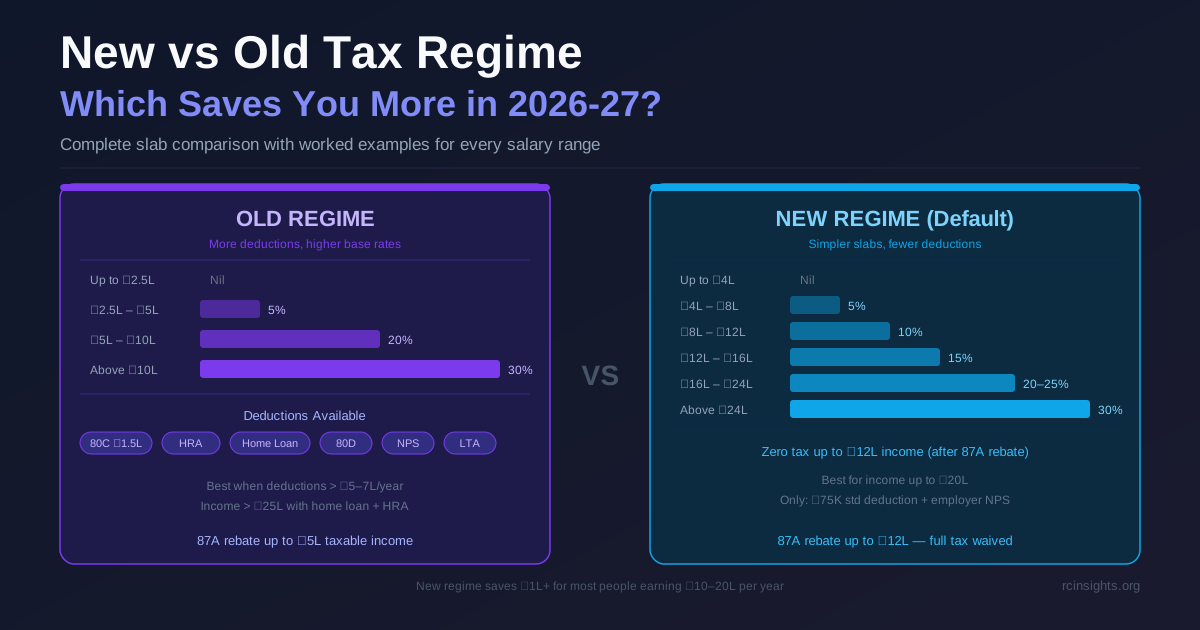
New regime (the default):
| Taxable income | Rate |
|---|---|
| Up to ₹4 lakh | Nil |
| ₹4–8 lakh | 5% |
| ₹8–12 lakh | 10% |
| ₹12–16 lakh | 15% |
| ₹16–20 lakh | 20% |
| ₹20–24 lakh | 25% |
| Above ₹24 lakh | 30% |
- Standard deduction: ₹75,000 for salaried people.
- Rebate: if taxable income is ₹12 lakh or less, the rebate wipes out the tax completely. With the standard deduction, that means no tax on salary up to ₹12.75 lakh.
- Marginal relief: just above ₹12 lakh, your tax can't exceed the amount by which you crossed ₹12 lakh, so there's no sudden cliff.
- Deductions: almost none. The main ones left are the employer's NPS contribution (80CCD(2), up to 14% of basic salary) and the employer's EPF contribution, within the usual limits.
Old regime (opt in):
| Taxable income | Rate |
|---|---|
| Up to ₹2.5 lakh | Nil |
| ₹2.5–5 lakh | 5% |
| ₹5–10 lakh | 20% |
| Above ₹10 lakh | 30% |
- Standard deduction: ₹50,000. It was never raised to ₹75,000 in the old regime, a detail many articles get wrong.
- Rebate: taxable income up to ₹5 lakh pays no tax.
- Deductions: the full list. 80C (₹1.5 lakh), 80D health insurance, NPS 80CCD(1B) (₹50,000), HRA, home-loan interest on a self-occupied house (up to ₹2 lakh), LTA, education-loan interest, and more.
Tax at each salary
"Deductions" here means everything you'd claim in the old regime beyond its ₹50,000 standard deduction: 80C, 80D, HRA, home loan and so on.
| Salary | New regime | Old, ₹1.5 L deductions | Old, ₹2 L | Old, ₹3.5 L | Old, ₹5 L | Old regime wins only if deductions exceed |
|---|---|---|---|---|---|---|
| ₹8 L | ₹0 | ₹33,800 | ₹23,400 | ₹0 | ₹0 | ₹2.5 L (and even then it only ties at zero) |
| ₹10 L | ₹0 | ₹75,400 | ₹65,000 | ₹33,800 | ₹0 | ₹4.5 L (to tie at zero) |
| ₹12.75 L | ₹0 | ₹1,40,400 | ₹1,24,800 | ₹91,000 | ₹59,800 | ₹7.25 L (to tie at zero) |
| ₹15 L | ₹97,500 | ₹2,10,600 | ₹1,95,000 | ₹1,48,200 | ₹1,06,600 | ≈ ₹5.45 L |
| ₹18 L | ₹1,50,800 | ₹3,04,200 | ₹2,88,600 | ₹2,41,800 | ₹1,95,000 | ≈ ₹6.45 L |
| ₹20 L | ₹1,92,400 | ₹3,66,600 | ₹3,51,000 | ₹3,04,200 | ₹2,57,400 | ≈ ₹7.1 L |
| ₹25 L | ₹3,19,800 | ₹5,22,600 | ₹5,07,000 | ₹4,60,200 | ₹4,13,400 | ≈ ₹8 L |
| ₹30 L | ₹4,75,800 | ₹6,78,600 | ₹6,63,000 | ₹6,16,200 | ₹5,69,400 | ≈ ₹8 L |
| ₹40 L | ₹7,87,800 | ₹9,90,600 | ₹9,75,000 | ₹9,28,200 | ₹8,81,400 | ≈ ₹8 L |
Two things stand out.
Up to ₹12.75 lakh, the new regime is simply zero tax. The best the old regime can do is tie at zero, and only with large deductions.
Above about ₹24 lakh, the break-even stops moving, at roughly ₹8 lakh. Both regimes charge 30% at the top, so the gap between them is a fixed amount. You need about ₹8 lakh of deductions to close it, which means something like the full 80C, NPS, the ₹2 lakh home-loan interest cap and a big HRA claim.
Two examples, step by step
Salary ₹15 lakh, with ₹2 lakh of deductions (80C maxed + ₹50k NPS):
New regime:
- Taxable income: ₹15,00,000 − ₹75,000 = ₹14,25,000
- Tax: 5% of ₹4 L (₹20,000) + 10% of ₹4 L (₹40,000) + 15% of ₹2.25 L (₹33,750) = ₹93,750
- Plus 4% cess: ₹97,500
Old regime:
- Taxable income: ₹15,00,000 − ₹50,000 − ₹2,00,000 = ₹12,50,000
- Tax: 5% of ₹2.5 L (₹12,500) + 20% of ₹5 L (₹1,00,000) + 30% of ₹2.5 L (₹75,000) = ₹1,87,500
- Plus 4% cess: ₹1,95,000
The new regime saves ₹97,500 a year. Maxing out 80C and NPS isn't nearly enough to change that.
Salary ₹13 lakh (just past the zero-tax line), new regime:
- Taxable income: ₹12,25,000, which is ₹25,000 over ₹12 lakh
- Tax by the slabs alone would be ₹63,750
- Marginal relief caps it at the ₹25,000 excess
- Plus 4% cess: ₹26,000
Who should still look at the old regime
You're a candidate only if your deductions are close to the break-even for your salary. In practice, that usually means you have:
- A home loan on a house you live in, with interest near the ₹2 lakh cap, plus
- A large HRA exemption because you pay substantial rent in a metro, or other large deductions, plus
- 80C and 80D already maxed out.
Add up what you can actually claim. Proofs your employer will accept, not plans. Compare that with the last column of the table.
Everyone else, which is most salaried people below ₹20 lakh, should be on the new regime, and should stop buying products in March just to save tax.
Switching between regimes
- Salaried, with no business income: you can choose either regime every year, when you file your return. The choice you give your employer in April only affects how much TDS they deduct. If you pick differently at filing time, you get a refund or pay the difference.
- With business or professional income (freelancers, consultants): it's restrictive. Once you leave the new regime, you can come back to it only once.
Tell payroll early either way, so your monthly TDS is roughly right and you don't face a big bill or a long wait for a refund.
If you choose the new regime
Your investments don't change. Only the tax angle does:
- ELSS loses its point. Without the deduction, a regular index fund does the same job with no lock-in.
- PPF is still tax-free on interest and maturity. A guaranteed 7.1% tax-free is still good for safe, long-term money.
- NPS: your own contributions get no deduction, but your employer's contribution (80CCD(2)) still does. Ask HR whether it's available in your salary structure.
- Health insurance is still essential, deduction or not.
The ELSS vs PPF vs NPS comparison goes into these in more detail.