Best SIP for ₹5,000 Per Month — Which Mutual Funds to Choose in 2026
₹5,000/month is one of the most common SIP amounts for new investors. Here's what it grows to, which fund categories to pick, and how to build a simple portfolio that works.

Ram
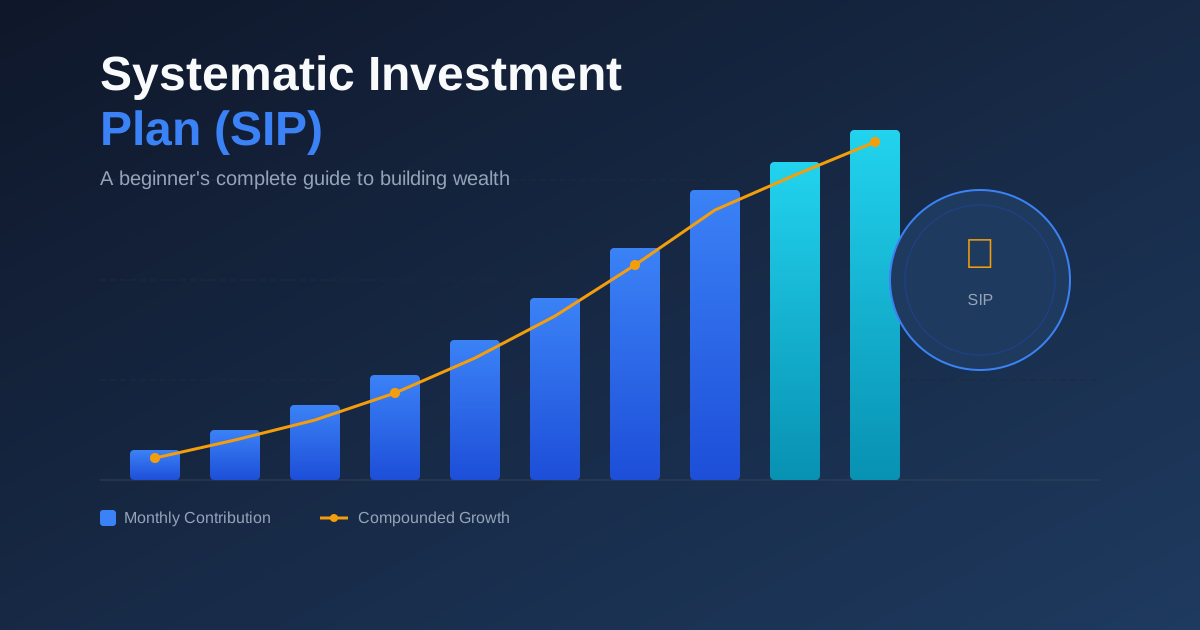
₹5,000 per month is the entry point for serious wealth creation through SIP. It's accessible enough for most working professionals, yet meaningful enough to build substantial wealth over time. Let's be precise about what it can do and where to put it.
Before diving in, use our SIP Calculator to run your exact numbers — tenure, return rate, and final corpus — as you read.
What ₹5,000/Month Actually Grows To
At 12% expected annual return (conservative estimate for equity mutual funds):
| Tenure | Total Invested | Estimated Corpus | Gain |
|---|---|---|---|
| 5 years | ₹3 lakhs | ₹4.1 lakhs | ₹1.1 lakhs |
| 10 years | ₹6 lakhs | ₹11.6 lakhs | ₹5.6 lakhs |
| 15 years | ₹9 lakhs | ₹25 lakhs | ₹16 lakhs |
| 20 years | ₹12 lakhs | ₹49.9 lakhs | ₹37.9 lakhs |
| 25 years | ₹15 lakhs | ₹94.9 lakhs | ₹79.9 lakhs |
The Right Fund Category for Your Goal
If Your Goal Is 10+ Years Away (Retirement, Child's Education)
Recommendation: Flexi-Cap Fund or Large & Mid-Cap FundThese funds invest across market capitalizations without restriction, giving fund managers flexibility to shift between large, mid, and small caps based on market conditions. They balance growth potential with reasonable stability.
Why not pure small-cap or mid-cap for 10+ years? Because the volatility is extreme — 50-60% drawdowns during crashes test most investors' resolve. Flexi-cap funds offer 14-16% CAGR historically with more manageable drawdowns of 30-40%.
If Your Goal Is 5-7 Years Away (House Down Payment, Car, Wedding)
Recommendation: Large-Cap Fund or Index Fund (Nifty 50)Large-cap funds invest in India's top 100 companies by market cap. Lower return potential (10-12% CAGR) but significantly lower volatility than mid/small cap. For a 5-7 year horizon, this is the appropriate risk level.
Index funds tracking Nifty 50 are a sub-category worth considering: ultra-low expense ratios (0.1-0.2% vs 1-1.5% for active funds), consistent benchmark performance, and no fund manager risk.
If You Want Maximum Growth and Have 15+ Years
Recommendation: 60% Flexi-Cap + 40% Mid-CapFor young investors (20s-30s) with long horizons and high risk tolerance, a combination of flexi-cap and mid-cap provides superior long-term return potential. Mid-cap funds have historically delivered 16-20% CAGR over 15+ year periods, significantly outperforming large-cap funds.
The drawback: mid-cap funds can fall 50-60% during bear markets. This is not a problem if you continue SIP during the fall — you buy units at deeply discounted prices.
If You Want Tax Savings (80C Benefit)
Recommendation: ELSS (Equity Linked Savings Scheme)ELSS funds are equity mutual funds with a mandatory 3-year lock-in. Investments qualify for Section 80C deduction up to ₹1.5 lakhs/year — saving up to ₹46,800 in taxes annually for someone in the 30% bracket.
₹5,000/month ELSS SIP = ₹60,000/year = ₹18,000 tax saving at 30% tax rate.
ELSS funds also have the shortest lock-in among all 80C instruments (PPF has 15 years, NSC has 5 years).
Building a ₹5,000/Month SIP Portfolio
Simple Portfolio (Beginner)
| Fund | Monthly SIP | Category |
|---|---|---|
| Index Fund (Nifty 50) | ₹3,000 | Large-Cap / Passive |
| ELSS Fund | ₹2,000 | Tax-saving + Equity |
| Total | ₹5,000 |
Balanced Portfolio (Intermediate)
| Fund | Monthly SIP | Category |
|---|---|---|
| Flexi-Cap Fund | ₹2,500 | Multi-cap growth |
| Mid-Cap Fund | ₹1,500 | Higher growth |
| ELSS Fund | ₹1,000 | Tax savings |
| Total | ₹5,000 |
The Step-Up Strategy: From ₹5,000 to Crores
The most powerful improvement you can make to a ₹5,000 SIP is increasing it by 10% every January.
| Strategy | Corpus After 20 Years |
|---|---|
| ₹5,000 flat for 20 years | ₹49.9 lakhs |
| ₹5,000 with 10% annual step-up | ₹92 lakhs |
Most major platforms (Groww, Zerodha Coin, Kuvera) support step-up SIP as an automated feature — set it once and forget it.
Which Platform to Use for SIP in India?
| Platform | Best For |
|---|---|
| Zerodha Coin | Zero commission, direct plans, good UI |
| Groww | Best mobile experience, good for beginners |
| Kuvera | Goal-based investing, multiple goals tracking |
| MFCentral | Direct plans, no-frills interface |
| AMC Website | Direct investment with the fund house |
Common Mistakes to Avoid
- Stopping SIP during market crashes — this is when SIP works hardest for you
- Too many funds — 4+ funds with the same category is redundant diversification
- Choosing funds based on 1-year returns — recent performance is a poor predictor
- Ignoring expense ratio — a 1.5% expense ratio vs 0.2% costs ₹8-10 lakhs over 20 years on a ₹5,000 SIP
- Regular plans instead of direct — avoidable loss of 0.5-1% annually
The Only SIP Rule That Matters
Start today. Increase annually. Never stop.
₹5,000/month for 20 years at 12% = ₹49.9 lakhs. The same investment started 5 years later yields only ₹23.2 lakhs for 15 years. Those 5 years cost you ₹26.7 lakhs. Time is the most critical input in the SIP formula — not which fund you pick.
Use our SIP Calculator to calculate your exact projected corpus, then start your SIP on the same day.
How to Track Your SIP Portfolio
Once your SIP is running, visibility matters. Here's how to monitor without obsessing:
Where to Check Portfolio Value
- Groww / Zerodha Coin / Kuvera app: Real-time portfolio value, returns, and fund performance
- MFCentral (mfcentral.com): AMFI's official portal — consolidated portfolio view across all AMCs
- CAMS / KFin online: Consolidated Account Statement (CAS) shows every folio across all funds
What to Check (Monthly)
- Current portfolio value vs total invested: Is the gap growing? It should be over time.
- Fund performance vs benchmark: Is your fund beating its benchmark index over 3 and 5 year periods?
- Step-up reminder: Is it January? Time to increase your SIP by 10%.
What NOT to Check Daily
- Daily NAV fluctuations — watching daily movements creates anxiety and leads to panic decisions
- Short-term returns (1-month, 3-month) — meaningless noise for long-term SIP investors
- Comparison with Nifty during short periods — SIP return comparison requires identical investment period calculations (XIRR), not direct NAV comparison
Tax Planning Around Your ₹5,000 SIP
If your ₹5,000 SIP is in an ELSS fund, you're investing ₹60,000/year — qualifying for ₹60,000 in Section 80C deduction.
| Tax bracket | Annual 80C deduction | Tax saved per year |
|---|---|---|
| 5% (income up to ₹5L) | ₹60,000 | ₹3,120 |
| 20% (income ₹10L-15L) | ₹60,000 | ₹12,480 |
| 30% (income above ₹15L) | ₹60,000 | ₹18,720 |
Long-Term Wealth Milestones with ₹5,000/Month SIP
A ₹5,000/month SIP at 12% CAGR crosses these milestones:
| Milestone | When it happens |
|---|---|
| Total corpus = 2× invested amount | ~Year 6-7 |
| Portfolio hits ₹10 lakhs | ~Year 8.5 |
| Portfolio hits ₹25 lakhs | ~Year 15 |
| Portfolio hits ₹50 lakhs | ~Year 20 |
| Portfolio hits ₹1 crore | ~Year 25 |