SIP vs Lumpsum: Which Investment Strategy Wins? [2026 Calculator Comparison]
SIP or lumpsum — the age-old question every Indian investor faces. The answer isn't simple, but the math is. Here's how to decide based on your situation.

Ram
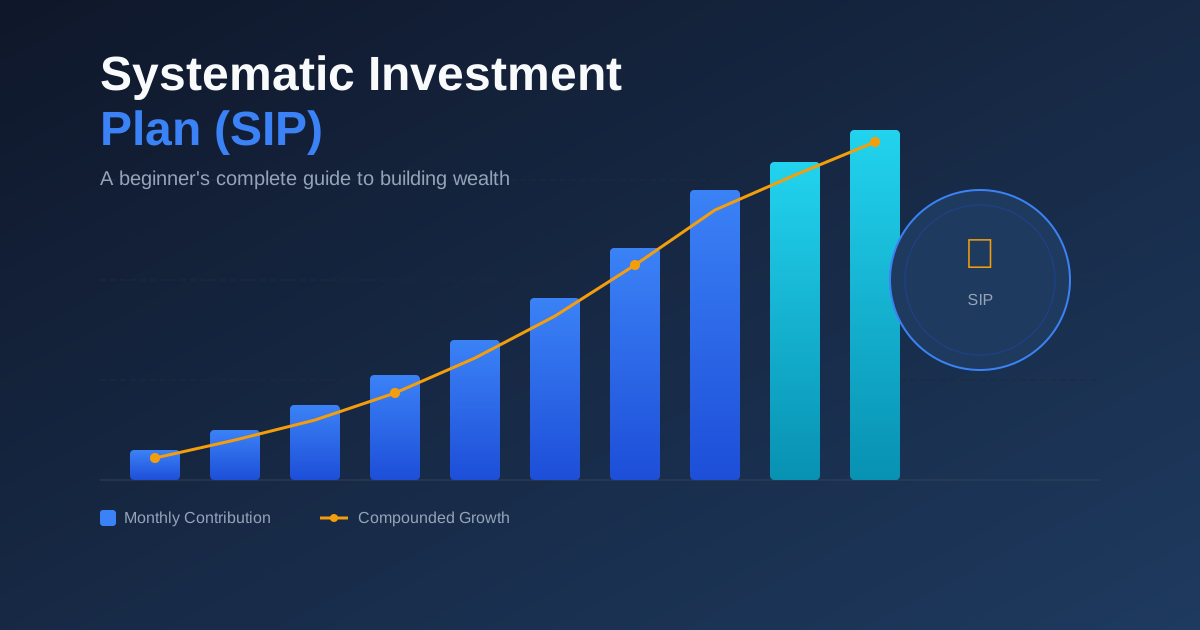
Every investor eventually faces this question: should I invest a fixed amount every month (SIP), or put everything in at once (lumpsum)? Financial advisors give conflicting answers. Let's settle it with numbers.
The Short Answer
Neither is universally better. The optimal choice depends on three factors: market valuation, your risk tolerance, and whether you have a large lump sum available. In most cases, for most people, SIP wins on practicality. In some market conditions, lumpsum wins on returns.
Use our free SIP Calculator and Lumpsum Calculator to model your specific scenario.
How Each Strategy Works
Systematic Investment Plan (SIP)
A SIP invests a fixed amount — say ₹10,000 — on the same date every month, regardless of market conditions. When the market falls, you buy more units at lower prices. When the market rises, you buy fewer units at higher prices. Over time, this averages your cost per unit.
The SIP formula:
FV = P × [(1 + r)^n – 1] / r × (1 + r)Lumpsum Investment
A lumpsum deploys your entire available capital at once. You buy all units at today's market price — locking in the current NAV across your entire investment.
The lumpsum formula:
FV = PV × (1 + r)^nThe Mathematical Reality: Three Scenarios
Let's compare ₹12 lakhs invested in each strategy at 12% CAGR over 10 years:
Scenario 1: Steady Bull Market
In a market that rises consistently year after year, lumpsum wins decisively. You deploy all capital early at a lower price, and all of it compounds for the full 10 years.
- Lumpsum ₹12L at 12% for 10 years: ₹37.2 lakhs
- SIP ₹10K/month for 10 years at 12%: ₹23.2 lakhs
Scenario 2: Volatile Market (Real World)
Markets don't move in straight lines. They crash 30-40% every 5-7 years (2008, 2020, 2022 corrections). During crashes, SIP buys units at deeply discounted prices, dramatically lowering average cost.
In volatile markets with a major correction mid-period:
- Lumpsum: Returns similar to scenario 1 but with significant drawdown anxiety
- SIP: Often matches or exceeds lumpsum due to buying heavy during corrections
Scenario 3: Investing at a Market Peak
This is the lumpsum investor's nightmare. If you invest your entire ₹12 lakhs when the market is at a 52-week high just before a 30% correction, your portfolio immediately drops to ₹8.4 lakhs. Recovery takes 2-3 years.
The same ₹12 lakhs deployed as ₹1L/month catches the bottom of the crash, buying units at 30% discount during the lowest months, and recovers much faster.
Winner: SIP — by a significant margin.When Lumpsum Is Clearly Better
| Situation | Why Lumpsum Wins |
|---|---|
| Markets down 25%+ from peak | You're investing at a discount — every rupee buys more |
| You received a large one-time amount | Letting it sit in savings account costs you returns |
| Investing in debt funds | Lower volatility makes timing less important |
| Short investment horizon (under 3 years) | Less time for SIP averaging to work |
| Situation | Why SIP Wins |
|---|---|
| Markets near all-time highs | Reduces risk of investing at peak |
| You have regular monthly income | SIP aligns naturally with salary cycles |
| You're a first-time investor | Removes psychological barrier of timing decisions |
| Long horizon (10+ years) | Compounding on accumulated units works powerfully |
| You lack a large lump sum | SIP makes investing accessible from ₹500/month |
Most sophisticated Indian investors don't choose between SIP and lumpsum — they use both:
- Maintain a regular SIP (₹5,000–₹25,000/month) for wealth accumulation
- Deploy lumpsum during corrections — when Nifty drops 15%+, add extra money
- Deploy annual bonuses as lumpsum into existing SIP funds rather than spending
Real Example: ₹1 Lakh Bonus, 2 Choices
You receive ₹1 lakh annual bonus. Option A: add it to your SIP fund as a lumpsum. Option B: increase your monthly SIP by ₹8,333 (₹1L ÷ 12 months).
At 12% CAGR for 15 years:
- Option A (lumpsum now): ₹1 lakh becomes ₹5.47 lakhs
- Option B (spread over 12 months): Slightly lower final amount because capital compounds for less time
The Final Verdict
For regular monthly investors with earned income: SIP is better. It removes timing decisions, enforces discipline, and averages your cost automatically.
For lump sum events (bonus, inheritance, FD maturity): invest immediately if markets are neutral to low. If markets are at record highs, use a 3–6 month STP (Systematic Transfer Plan) instead.
Use both calculators to model your exact scenario:- SIP Calculator — project monthly investment returns
- Lumpsum Calculator — project one-time investment returns
Tax Implications: SIP vs Lumpsum
Investment strategy also affects how you're taxed, and this is often overlooked in SIP vs lumpsum comparisons.
SIP Tax Treatment
Each SIP instalment is treated as a separate investment for tax purposes. This means each monthly instalment starts its own holding period clock. For a SIP started in January 2020:
- The January 2020 instalment qualifies for LTCG treatment after January 2021
- The February 2020 instalment qualifies after February 2021
- And so on for each subsequent instalment
For equity mutual funds: LTCG at 12.5% applies to gains above ₹1.25 lakh per year. STCG at 20% applies to gains on units held under 12 months.
Lumpsum Tax Treatment
A lumpsum investment starts one holding period clock. Invest ₹12 lakhs in one shot in January 2020, and all of it qualifies for LTCG after January 2021. Simpler from a tax calculation perspective.
Which Is More Tax-Efficient?
Over long horizons, both strategies end up in LTCG territory and the difference is minimal. However:
- Short-horizon investors (under 3 years): Both attract STCG; lumpsum may have slightly more tax impact if invested at a high NAV
- Long-horizon investors (10+ years): Tax treatment is nearly identical; both eventually become LTCG on all gains
Common Mistakes Investors Make
Mistake 1: Artificial SIP-ification of Lump Sums
Some advisors recommend spreading a lump sum across 12 monthly installments to "reduce risk." This is mathematically suboptimal if you have the money now — you delay returns on money that could be compounding from day one.
The better approach: If you have a lumpsum and markets are not at extreme valuations, invest immediately. If markets are at peak (Nifty P/E above 25-28), use a 3-month STP (Systematic Transfer Plan) from a liquid fund, not 12 months.Mistake 2: Stopping SIP Because of Market Crash
This is the most common and costly mistake. SIP works precisely because it buys more units when markets fall. Stopping SIP during a crash is like stopping grocery shopping because prices are low — it makes no sense.
During the COVID crash of March 2020, Nifty fell 38% in 30 days. Investors who kept SIPs running bought units at massive discounts. By September 2020 (6 months later), markets had fully recovered. Those SIP units bought at the bottom doubled in value.
Mistake 3: Using 1-Year Returns to Compare
SIP performance should never be evaluated over 1-3 year windows. Due to rupee cost averaging, SIP's advantage is most visible over 10+ year periods that include at least one full market cycle. Short-term comparisons almost always make lumpsum look better in bull markets.
Mistake 4: Not Using STP for Large Lump Sums in High-PE Markets
If you receive a large bonus or inheritance during a market that looks richly valued:
- Park the full amount in a liquid fund immediately (don't let it sit in savings)
- Set up a Systematic Transfer Plan (STP) from the liquid fund to your equity fund — weekly or monthly over 3-6 months
- This earns liquid fund returns (~6-7%) on the waiting money while gradually averaging into equities
Calculating Which Strategy Wins for Your Situation
Use both our calculators to model your specific scenario:
Step 1: Define your goal
- How much do you need? By when?
- Do you have a lump sum available, or only monthly savings?
Step 2: Check market valuation
- Nifty 50 P/E below 20: Favorable for lumpsum
- Nifty 50 P/E 20-25: Neutral; STP over 3 months for lump sums
- Nifty 50 P/E above 25: Lean toward SIP or longer STP for lump sums
Step 3: Run the numbers
- SIP Calculator: Enter your monthly amount, expected return, and tenure
- Lumpsum Calculator: Enter your one-time amount, expected return, and tenure
- Compare the projected corpus values for your situation