SWP Calculator: How to Get Monthly Income from Mutual Funds in Retirement
SWP lets your mutual fund corpus pay you a regular monthly income — while the remaining corpus continues to earn returns. Here's how to plan a sustainable SWP that lasts 25-30 years.

Ram
Most Indian retirees default to Fixed Deposits for income — because they're familiar and "safe." But the math tells a different story. A ₹1 crore FD at 7% generates ₹58,333/month in interest but erodes the corpus's real value through inflation. A well-structured SWP can generate similar monthly income while allowing the corpus to potentially grow in real terms.
Use our SWP Calculator to model your exact scenario.
What Is a Systematic Withdrawal Plan?
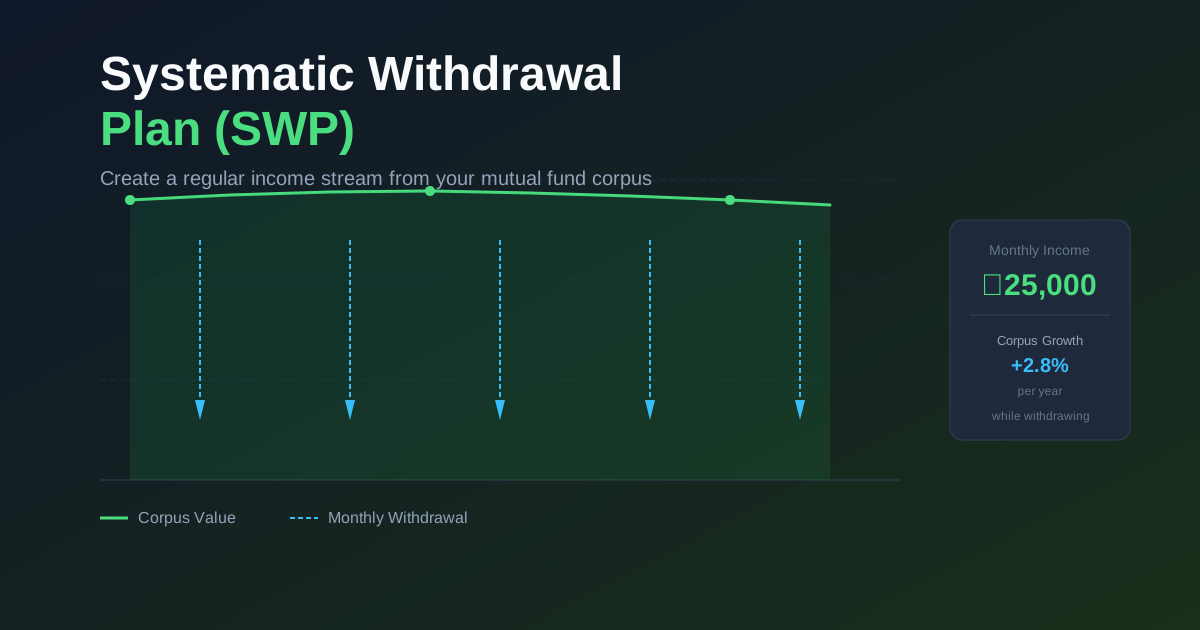
A Systematic Withdrawal Plan (SWP) is a facility that lets you withdraw a fixed amount from your mutual fund investment at regular intervals — typically monthly — while the remaining corpus continues to earn market returns.
The SWP mechanic:- You have ₹1 crore in a mutual fund (the corpus)
- You instruct the fund house to redeem ₹30,000 worth of units every month
- On the 5th of each month, the equivalent units are redeemed at that day's NAV, and ₹30,000 is credited to your bank account
- The remaining corpus continues earning returns
The Sustainable Withdrawal Rate
The critical question: how much can you withdraw monthly without depleting the corpus?
The 4% annual withdrawal rule (popularized in the US but applicable to India with adjustments) suggests withdrawing 4% of corpus annually, giving:
| Corpus | 4% Annual | Monthly Withdrawal |
|---|---|---|
| ₹50 lakhs | ₹2 lakhs/year | ₹16,667/month |
| ₹1 crore | ₹4 lakhs/year | ₹33,333/month |
| ₹2 crores | ₹8 lakhs/year | ₹66,667/month |
| ₹5 crores | ₹20 lakhs/year | ₹1,66,667/month |
SWP vs Fixed Deposit: A Real Comparison
Scenario: ₹1 crore retirement corpus, 20-year horizonFD Approach (7% annual interest)
- Monthly income: ₹58,333 (interest only, principal intact)
- Real value of ₹1 crore after 20 years at 6% inflation: ₹31 lakhs
- Monthly income in real terms after 20 years: ₹18,000 (severely eroded by inflation)
- Tax: Interest taxed at slab rate every year — at 30%, effective monthly income is ₹40,833
SWP Approach (₹30,000/month from balanced hybrid fund, 11% assumed return)
- Monthly income: ₹30,000 (fixed withdrawal)
- Corpus after 20 years: ₹1.85 crores (corpus has grown despite withdrawals)
- Real value of ₹1.85 crore after 20 years: ₹57 lakhs
- Tax: Only the gain portion of each redemption is taxed (LTCG at 10%), making effective tax much lower than FD
Choosing the Right Fund for SWP
Conservative Choice: Balanced Hybrid Funds (50-70% equity)
Monthly SWP draws from balanced hybrid funds benefit from equity growth while the debt component provides stability. Less volatile than pure equity funds, making corpus depletion less likely during market corrections.
Historical returns: 10-12% CAGR over 10+ year periods.
Moderate Choice: Flexi-Cap Equity Funds
Higher long-term return potential (12-15%) but greater short-term volatility. Suitable for retirees with a larger corpus, lower withdrawal rate, and some tolerance for portfolio fluctuations.
Conservative Choice: Monthly Income Plans / Debt Funds
For very conservative retirees or those with high income needs relative to corpus, debt-oriented funds provide more predictable returns (7-9%) with less volatility. Returns are lower but more stable.
How to Run SWP in India
Step 1: Accumulate the Corpus
You need a corpus large enough to sustain your desired monthly income at a safe withdrawal rate. Use our SIP Calculator to plan your accumulation phase.
Target corpus = Desired monthly income × 300 (approximation for 30-year sustainability at 4% withdrawal rate).
Step 2: Choose the Right Fund
Transfer your corpus to a balanced hybrid or flexi-cap fund (if in equities) or a conservative hybrid fund (if risk-averse). Don't start SWP immediately after retirement — give the corpus 1-2 years to settle at your chosen fund.
Step 3: Set Up SWP
On your mutual fund platform (Groww, Kuvera, Zerodha Coin, or AMC website):
- Go to the fund → Select SWP/Withdrawal
- Set monthly withdrawal amount
- Set withdrawal date (align with your expense date)
- Set bank account for credit
Step 4: Annual Review
Every January, review:
- Is the corpus growing, stable, or declining?
- Has inflation required a withdrawal increase?
- Are returns in line with projections?
Sequence of Returns Risk
The biggest risk in SWP is a major market decline in the first 3-5 years of retirement. If the market falls 40% in Year 1 and you withdraw ₹30,000/month, you're selling units at depressed prices — permanently reducing your corpus.
Mitigation strategies:- 2-year cash buffer: Keep 2 years of withdrawals in a liquid fund or FD. Draw from this during market downturns instead of your equity fund.
- Dynamic withdrawal: Reduce SWP amount during market downturns (if your budget allows)
- Conservative allocation: A 50/50 equity-debt split limits drawdown severity
SWP Tax Efficiency
Each SWP withdrawal is treated as a redemption of mutual fund units. The tax applies only to the gain portion — not the full withdrawal amount.
Example: You withdraw ₹30,000. Of this, ₹22,000 is original cost and ₹8,000 is gain. Tax applies only on ₹8,000.For equity funds held over 12 months: LTCG at 10% on ₹8,000 = ₹800 tax. For FD: ₹30,000 monthly interest is fully taxable at slab rate — at 30%, that's ₹9,000 tax.
SWP is significantly more tax-efficient than FD for retirement income.Planning Your Retirement SWP
Use our SWP Calculator to model your situation:
- Enter your expected retirement corpus
- Set your desired monthly withdrawal
- Enter expected annual return (use 10-11% for balanced hybrid, 12% for equity)
- See how many years the corpus lasts
- What if I reduce monthly withdrawal by ₹5,000?
- What if returns are only 8% instead of 11%?
- What corpus do I need for my withdrawal to never touch principal?
For SWP to work, you first need to build the corpus. Start with our SIP Calculator to plan how to reach your retirement corpus target.
Building Toward Your SWP Corpus
The SWP strategy requires a substantial corpus before it works sustainably. For most middle-class Indian households, getting there requires a long SIP journey.
Reverse planning your SWP corpus target:- Desired monthly SWP income: ₹50,000
- Safe withdrawal rate (India): 4% annually
- Required corpus: ₹50,000 × 12 ÷ 4% = ₹1.5 crore
Use our SIP Calculator to plan how long it takes to reach this corpus from your current savings rate.
| Monthly SIP | At 12% for 20 years | At 12% for 25 years |
|---|---|---|
| ₹10,000 | ₹99.9 lakhs | ₹1.89 crores |
| ₹15,000 | ₹1.5 crores | ₹2.84 crores |
| ₹20,000 | ₹2.0 crores | ₹3.79 crores |
| ₹25,000 | ₹2.5 crores | ₹4.74 crores |
Frequently Asked Questions
How do I choose the SWP date in the month? Pick a date that aligns with your major expenses — typically 1st-5th if rent/EMI is due at the start of the month. This ensures money arrives before bills fall due. Most AMCs allow date selection during SWP setup. What if I need more income in some months than others? You can modify your SWP amount upward or downward at any time — most AMC platforms and apps allow this within 2-3 business days. Alternatively, maintain a liquid fund buffer of 3-6 months of expenses alongside your SWP fund. Draw extra from the liquid fund in high-expense months and replenish from SWP in lean months. Is SWP better for retirement than Senior Citizen Savings Scheme (SCSS)? Each serves a different purpose. SCSS offers guaranteed 8.2% interest, government-backed, tax-free up to ₹50,000 under Section 80TTB, and is ideal for risk-averse retirees wanting certainty. SWP offers higher potential returns (10-12% from equity hybrid funds) but with market risk. The optimal retirement income strategy often combines both: SCSS for guaranteed base income, SWP for inflation-beating growth component. How long before retirement should I start planning SWP? At least 3-5 years before retirement. This gives you time to: gradually shift your SIP portfolio from aggressive equity toward balanced hybrid funds, build the 2-year cash buffer, and study your expected monthly expenses to calibrate the withdrawal amount. Don't wait until the day you retire to think about SWP structure. What is a Step-Up SWP? Just as Step-Up SIP increases your investment amount annually, a Step-Up SWP increases your withdrawal amount by 3-5% annually — matching inflation. This ensures your monthly income maintains its real purchasing power over a 25-30 year retirement, rather than staying flat while prices rise around it.SWP vs FD Interest: A Real Comparison with Numbers
The comparison between SWP and Fixed Deposit income is one of the most consequential decisions a retiree makes. Let's model it with real numbers across a 25-year retirement.
Baseline Assumptions
| Parameter | FD Route | SWP Route |
|---|---|---|
| Starting corpus | ₹1 crore | ₹1 crore |
| Monthly income withdrawn | ₹58,333 (7% interest) | ₹30,000 (conservative SWP) |
| Annual return on corpus | 7% (FD rate) | 11% (balanced hybrid fund) |
| Inflation | 6% per year | 6% per year |
| Tax assumption | 30% slab | 10% LTCG (equity gains only) |
| Metric | FD | SWP |
|---|---|---|
| Gross monthly income | ₹58,333 | ₹30,000 |
| Tax deducted | ₹17,500 (30%) | ~₹600 (LTCG on gain portion only) |
| Net monthly income | ₹40,833 | ₹29,400 |
| Corpus after Year 1 | ₹1 crore (unchanged) | ₹1,07,20,000 (grown) |
Year 10 and Year 20 Comparison
FD Approach:- Monthly income: Still ₹58,333 (nominal) — but ₹58,333 in Year 10 buys only what ₹32,600 bought in Year 1 (at 6% inflation)
- Real purchasing power lost: 44% over 10 years
- Corpus: ₹1 crore (principal intact but real value is ₹55 lakhs at 6% inflation)
- Real corpus in Year 20: ₹31 lakhs (₹1 crore depreciated by 20 years of 6% inflation)
- Year 10 monthly withdrawal: ₹48,900 (₹30,000 with 5% annual increase)
- Real purchasing power: Approximately maintained
- Corpus in Year 10: ₹1.28 crores (grown despite withdrawals at 11% return)
- Corpus in Year 20: ₹1.85 crores (significant growth despite 20 years of withdrawals)
The Long-Term Reality
Over 25 years, the SWP route, despite starting with lower monthly income, produces:
- A growing corpus that can sustain or increase income
- Significantly lower real tax burden
- Inflation-adjusted withdrawal ability via step-up SWP
- A substantial corpus to leave as inheritance or for late-retirement care costs
Tax Treatment of SWP Withdrawals
One of the most misunderstood aspects of SWP is how the withdrawals are taxed. The favorable tax treatment is a key advantage over FD income.
How SWP Redemptions Are Taxed
Each monthly SWP withdrawal is treated as a partial redemption of mutual fund units. The FIFO (First In First Out) rule applies — oldest units are redeemed first.
Tax is levied only on the GAIN portion, not the full withdrawal: Example month:- Withdrawal amount: ₹30,000
- Cost of redeemed units (original investment): ₹21,500
- Gain on these units: ₹8,500
- Applicable tax: LTCG at 10% on ₹8,500 = ₹850
- Effective tax on ₹30,000 withdrawal: 2.8%
LTCG vs STCG in SWP
For equity/equity-hybrid funds:
- Units held more than 12 months: LTCG at 10% on gains above ₹1.25 lakh/year
- Units held less than 12 months: STCG at 20%
Debt Fund SWP Tax Treatment (for conservative SWPs)
If you run SWP from a debt mutual fund (e.g., for ultra-conservative retirees):
- Gains are taxed at your income tax slab rate (same as FD)
- No LTCG/STCG distinction for debt funds — all gains are income
How to Adjust SWP for Inflation
A flat ₹30,000/month SWP for 25 years means your real income halves due to inflation. The solution is a systematic annual step-up — the SWP equivalent of Step-Up SIP.
The Step-Up SWP Strategy
Increase your SWP withdrawal amount by 5-6% annually — matching India's average inflation rate. This keeps your real purchasing power stable.
Example: ₹30,000/month SWP with 5% annual step-up| Year | Monthly SWP | Real Value (at 6% inflation) |
|---|---|---|
| Year 1 | ₹30,000 | ₹30,000 |
| Year 5 | ₹36,465 | ₹27,280 |
| Year 10 | ₹46,540 | ₹26,000 |
| Year 15 | ₹59,430 | ₹24,800 |
| Year 20 | ₹75,860 | ₹23,600 |
Can the Corpus Survive a Step-Up SWP?
The key question: does the corpus last with the increasing withdrawals?
Modelled scenario: ₹1 crore corpus, ₹30,000 starting SWP, 5% annual step-up, 11% annual return:| Year | Annual Withdrawal | Corpus End-of-Year |
|---|---|---|
| Year 1 | ₹3,60,000 | ₹1,07,00,000 |
| Year 5 | ₹4,37,700 | ₹1,27,80,000 |
| Year 10 | ₹5,58,500 | ₹1,49,50,000 |
| Year 15 | ₹7,13,200 | ₹1,68,20,000 |
| Year 20 | ₹9,10,400 | ₹1,76,80,000 |
| Year 25 | ₹11,61,900 | ₹1,58,00,000 |
When to Start Increasing SWP
Most retirees hesitate to increase SWP because they fear depleting the corpus. Use this rule:
Increase SWP only if:- The corpus has grown year-on-year (despite withdrawals)
- The new withdrawal amount is still within the 4% annual withdrawal limit relative to current corpus size
- You have at least 2 years of withdrawals parked in a liquid fund as buffer
- Markets fell significantly in the prior year
- The corpus is flat or declining
- You dipped into your cash buffer during the year