Home Loan EMI: How Much Can You Afford, and How to Pay Less Interest
A ₹50 lakh home loan over 20 years at 8% costs about ₹50 lakh in interest, so you repay roughly double. Here's how to size the loan, cut that interest with early prepayments, and plan for the costs no one mentions.

Ram
A home loan is usually the biggest financial commitment people make, and the EMI hides how big it really is. This guide covers how EMIs work, how much you can sensibly borrow, what the loan really costs, and the few decisions that change that cost the most.
You can follow along in the EMI calculator. The examples below use 8% a year. Good-credit floating rates at major banks currently start around 7.1–7.75%, but your actual rate depends on your credit score, the lender, the loan amount and future RBI decisions.
General information, not personalised advice.
How an EMI works
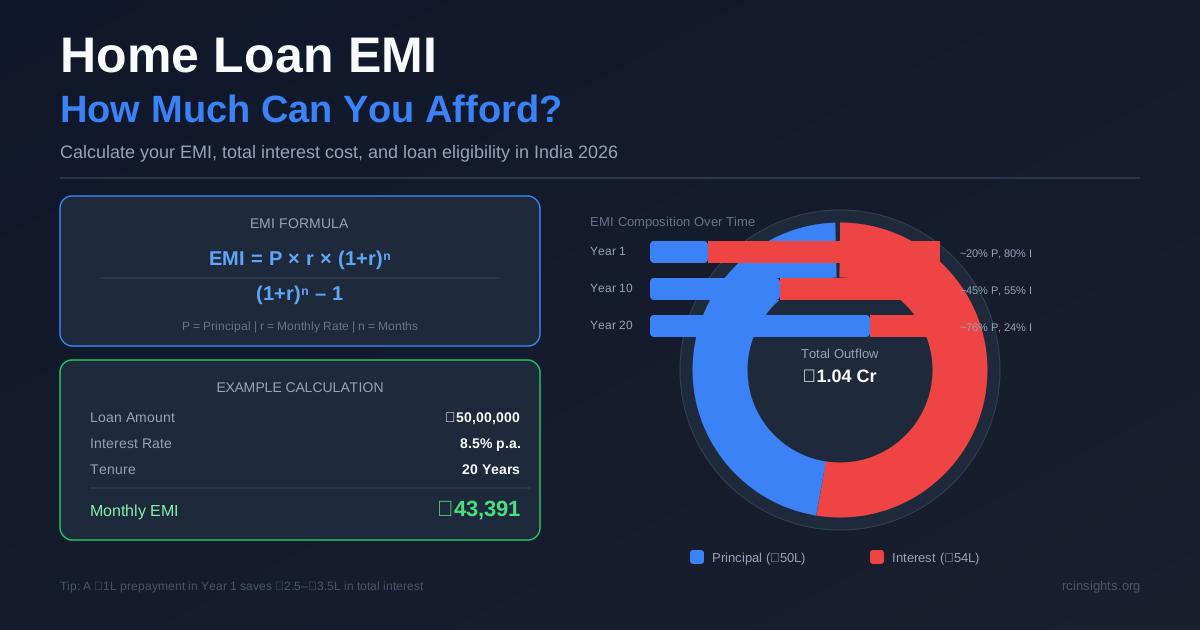
An EMI (equated monthly instalment) is a fixed monthly payment covering interest and repayment of the loan amount (principal). The split changes over time:
- Early on, most of each EMI is interest. On a 20-year loan at 8%, about 79% of what you pay in year one goes to interest.
- Later, most of it is principal. The balance falls slowly for years, then speeds up.
The formula, if you want it:
EMI = P × r × (1 + r)^n / [(1 + r)^n − 1]

P = loan amount, r = annual rate ÷ 12 ÷ 100, n = number of months
What the loan really costs
| Loan | Tenure | EMI (at 8%) | Total interest |
|---|---|---|---|
| ₹30 L | 15 years | ₹28,670 | ₹21.6 L |
| ₹30 L | 20 years | ₹25,093 | ₹30.2 L |
| ₹50 L | 20 years | ₹41,822 | ₹50.4 L |
| ₹50 L | 25 years | ₹38,591 | ₹65.8 L |
| ₹75 L | 20 years | ₹62,733 | ₹75.6 L |
Two things stand out:
- At 20 years, you pay back roughly double what you borrowed.
- Going from 20 to 25 years lowers the EMI by about ₹3,200, but adds about ₹15 lakh of interest on a ₹50 lakh loan. A longer tenure looks cheaper each month and is much more expensive overall.
Interest rates matter too. Each 1-point rise on a ₹50 lakh, 20-year loan adds about ₹3,200 to the EMI. With a floating rate, this happens when the bank resets your rate after an RBI change. Banks usually lengthen the tenure first and raise the EMI only if needed. That's easy not to notice, and it quietly adds years to your loan. Check your loan statement after every RBI rate change.
How much can you borrow, and how much should you?
Banks look at your FOIR (fixed obligations to income ratio): all your EMIs together, including the new one, as a share of your monthly income. Many lenders allow up to 50–60% for higher earners.
What a bank will lend you and what's comfortable are different things. A more cautious rule is to keep total EMIs under about 35–40% of your take-home pay. That still leaves room for SIPs, insurance, an emergency fund and normal life.
Example: take-home pay of ₹1,00,000 a month, with a comfortable EMI of ₹40,000. Over 20 years at 8%, that supports a loan of about ₹47.8 lakh. At 9%, it's about ₹44.5 lakh.
Then add the down payment (usually at least 10–25% of the property's value) and the costs below.
The costs that aren't in the EMI
At purchase:
- Stamp duty and registration: typically 5–8% of the property value combined, depending on the state. Some states offer lower rates for women buyers. On a ₹70 lakh home, that's roughly ₹4–5 lakh, paid from your own pocket, not the loan.
- Processing fee: typically up to 0.5–1% of the loan, often capped or waived during promotions. Negotiate it.
- Legal and technical valuation charges, and sometimes a fee for the loan agreement itself.
Ongoing:
- Insurance. Banks often push a single-premium loan insurance policy and add it to your loan. It's usually much cheaper to buy a plain term insurance policy for at least the loan amount yourself. Lenders generally can't make their own insurance product compulsory.
- Property tax and maintenance, and for apartments, monthly society charges.
Prepayment: the biggest lever you control
Any extra amount you pay goes straight to the principal, and that cuts the interest on everything that follows. The earlier you pay it, the more it saves.
₹1 lakh prepaid on a ₹50 lakh, 20-year loan at 8%, keeping the same EMI:
| Prepaid in | Interest saved | Loan ends earlier by |
|---|---|---|
| Year 1 | ~₹3.8 L | 11 months |
| Year 5 | ~₹2.5 L | 8 months |
| Year 10 | ~₹1.4 L | 5 months |
| Year 15 | ~₹0.6 L | 3 months |
Practical points:
- Choose "reduce tenure," not "reduce EMI," when you prepay. You'll save more interest. Choose the lower EMI only if your budget genuinely needs it.
- No penalty on floating-rate loans for individual borrowers. RBI rules prohibit foreclosure and prepayment charges on these. Fixed-rate loans may charge a fee, so read your agreement.
- Even a small yearly prepayment adds up. One extra EMI a year can take years off a 20-year loan.
When not to prepay
- Before your emergency fund is complete. Money paid into a home loan is very hard to get back out in a crisis.
- When it would stop you investing for long-term goals. Prepaying gives a guaranteed "return" equal to your loan rate, around 8% here. Long-term equity investing has historically done better, with ups and downs along the way. Many people split the difference: keep SIPs running and put bonuses towards prepayment.
- If your tax planning depends on the interest deduction. This applies only if you're on the old regime. See below.
Tax benefits, and what still applies
Home-loan tax benefits depend on which regime you're on and whether you live in the house.
Old regime, self-occupied home:
- Interest: deduction of up to ₹2 lakh a year (Section 24(b), carried into the new Income-tax Act, 2025).
- Principal: counts towards the ₹1.5 lakh 80C limit (now Section 123), shared with EPF, PPF, ELSS and insurance premiums. Stamp duty and registration also count, in the year you pay them.
- Section 80EEA (an extra ₹1.5 lakh on interest for first-time buyers) only applied to loans sanctioned between April 2019 and March 2022. It's not available for new loans, despite still appearing in many articles.
New regime, self-occupied home: no deduction for interest or principal.
Let-out property (either regime): interest can be deducted from the rental income. The rules differ on how much of a resulting loss you can set off against other income, so check before relying on it.
Joint home loans: each person can claim these deductions separately, but only if they're both a co-borrower and a co-owner, and each actually pays their share of the EMI.
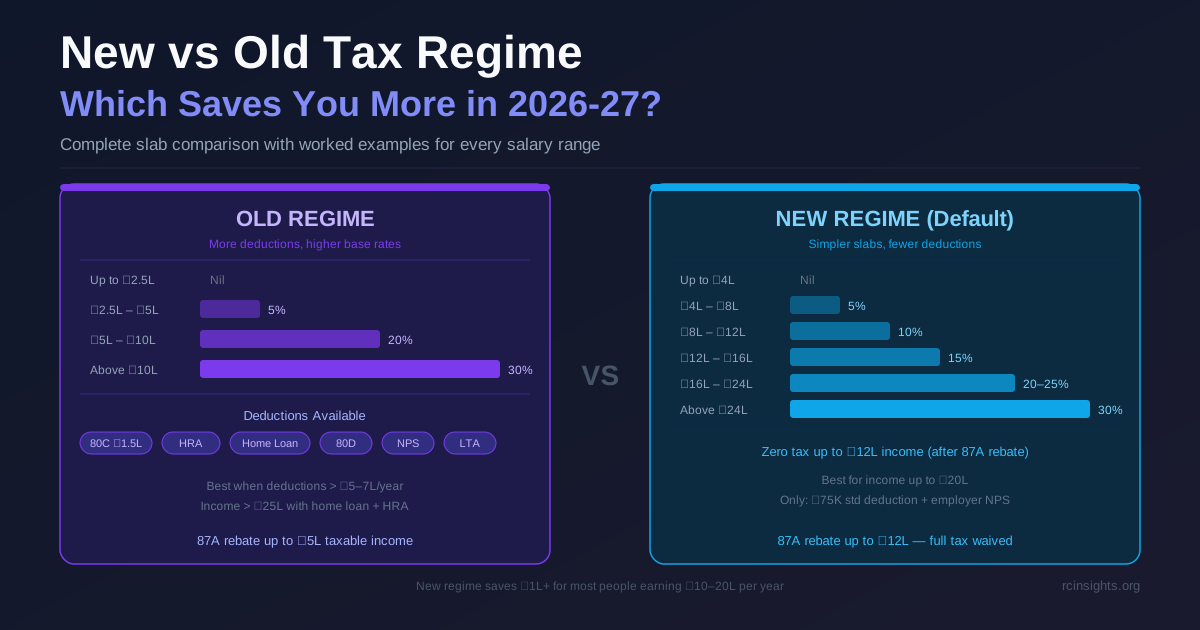
So, is the old regime worth it for a home loan? Only if your total deductions get close to the break-even for your income. That's usually about ₹5–8 lakh. The regime comparison has the numbers. A ₹2 lakh interest deduction alone doesn't get most people there.
Floating or fixed?
Most Indian home loans are floating, linked to an external benchmark like the repo rate. They:
- start cheaper,
- have no prepayment penalty, and
- fall when RBI cuts rates (and rise when it raises them).
Fixed rates start higher, and are often fixed only for the first few years before switching to floating. They suit people with no room in their budget for a higher EMI. For most borrowers who plan to prepay, floating is the better default.
Before you apply
- Check your credit score on CIBIL, Experian, Equifax or CRIF High Mark. Most lenders reserve their best rates for 750 and above. Pay off credit card balances and avoid new loan applications in the months before.
- Get quotes from at least three lenders, including a public-sector bank. Compare the rate, the processing fee and how the rate is reset. Not just the headline number.
- Ask for the sanction letter and key fact statement, and read the reset and prepayment clauses.
- Budget for stamp duty, registration, furnishing and a few months of buffer on top of the down payment.
Once you have a loan, review it every year. If another lender is offering at least 0.5% less and you still have many years to go, a balance transfer can save a lot. Often, simply asking your current bank to lower your rate gets you most of the way there for a small fee.