SIP Explained: A Beginner's Complete Guide to Systematic Investment Plans
SIP (Systematic Investment Plan) is one of the most powerful ways to build wealth over time. This guide breaks down how SIP works, its real benefits, risks to watch out for, and a step-by-step example.

Ram
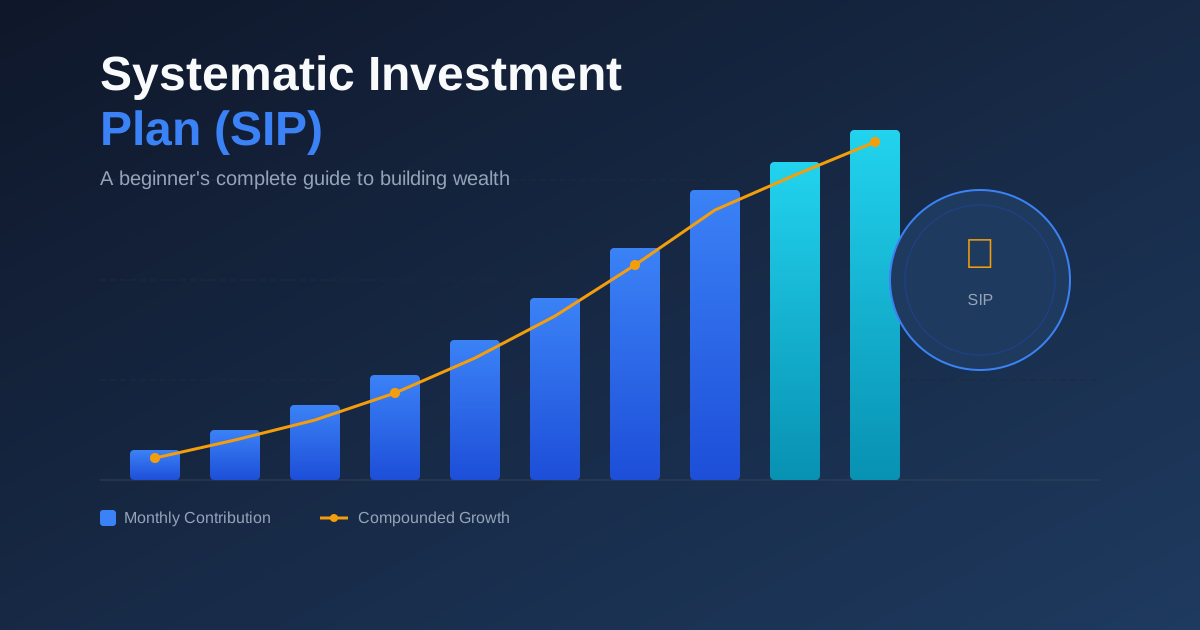
Building wealth doesn't require a windfall — it requires consistency. A Systematic Investment Plan (SIP) is arguably the most accessible and disciplined route to long-term wealth creation for retail investors. Here's everything you need to know.
What Is a Systematic Investment Plan (SIP)?
A Systematic Investment Plan (SIP) is a method of investing a fixed amount in a mutual fund at regular intervals — daily, weekly, monthly, or quarterly. Rather than trying to time the market, SIP lets you automatically invest through market highs and lows, leveraging the power of rupee cost averaging and compound interest.
SIPs are not a product — they are an investment mechanism applied to mutual fund schemes. You choose the fund; SIP is simply how you contribute to it.
How SIP Works
When you start a SIP:
- Authorization: You authorize your bank to auto-debit a fixed amount on a set date each month.
- Unit Allocation: On each debit date, units of your chosen mutual fund are purchased at the prevailing NAV (Net Asset Value).
- Accumulation: Over time, you accumulate units bought at different NAVs — averaging out your cost basis.
The Core Formula
SIP returns use compound interest logic:
$$ M = P \times \frac{\left[\left(1 + \frac{r}{n}\right)^{nt} - 1\right]}{\frac{r}{n}} \times \left(1 + \frac{r}{n}\right) $$
Where:
- M = Maturity amount
- P = Monthly investment
- r = Annual expected return rate (decimal)
- n = Number of compounding periods per year (12 for monthly)
- t = Investment tenure in years
Benefits of SIP
1. Rupee Cost Averaging
When markets dip, your fixed investment buys more units. When markets rise, you buy fewer. Over time, this averages your cost per unit below the average NAV — a mathematical edge that lump-sum investors don't get.2. Compounding — The Eighth Wonder
Einstein reportedly called compound interest "the eighth wonder of the world." In SIP, your returns earn returns. The earlier you start, the more dramatically compounding works in your favor.3. Disciplined Investing Without Emotion
Systematic automation removes impulse decisions. You invest regardless of market headlines — exactly the behavior that separates successful long-term investors from the rest.4. Low Entry Barrier
Most SIPs start at ₹500/month. You don't need large capital to begin.5. Flexibility
You can increase (Step-up SIP), pause, or stop your SIP at any time without penalty on most platforms.Risks to Understand
SIP is not risk-free. Here's what to watch:
| Risk | Description |
|---|---|
| Market Risk | Mutual funds are subject to market volatility. Returns are not guaranteed. |
| Fund Risk | Poor fund selection leads to underperformance vs. benchmarks. |
| Inflation Risk | If returns don't beat inflation, real wealth erodes. |
| Behavioral Risk | Stopping SIP during market crashes is the most common wealth-destroying mistake. |
- Total Invested: ₹9,00,000
- Estimated Returns: ₹16,22,880
- Total Corpus: ₹25,22,880
How to Start a SIP in 2026
- Complete KYC via your PAN and Aadhaar
- Choose a platform: Zerodha Coin, Groww, Kuvera, or directly via AMC websites
- Select a fund category: Large-cap, mid-cap, ELSS (tax-saving), or flexi-cap
- Set your SIP date and amount
- Stay invested — do not stop during corrections
SIP vs Lump Sum
| Factor | SIP | Lump Sum |
|---|---|---|
| Entry timing risk | Low | High |
| Best market condition | Volatile / falling | Bull market bottom |
| Minimum capital | Low (₹500+) | High |
| Discipline required | Auto through mandate | Self-managed |
SIP is not exciting — and that's precisely what makes it powerful. Automation, consistency, and compounding do what discipline alone cannot. If you haven't started yet, the best time is now.
Next: Understand how to exit systematically with SWP (Systematic Withdrawal Plan). And use the SIP Calculator to model your investment journey.Types of SIP
Not all SIPs are the same. Understanding the variants helps you choose the right structure.
Regular SIP
The standard type. A fixed amount debited on the same date every month. Simple, automatic, and suitable for most investors.Step-Up SIP (Top-Up SIP)
Automatically increases your SIP amount by a fixed percentage — typically 10% — every year. This aligns with natural salary growth and dramatically increases your final corpus. A ₹5,000/month SIP with 10% annual step-up over 20 years produces nearly double the corpus of a flat ₹5,000 SIP. Most platforms support this as a configurable option during SIP setup. Read the full guide on Step-Up SIP.Flexible SIP
Lets you vary the SIP amount from month to month — useful if your income is irregular (freelancers, business owners). You set a minimum amount, and increase it whenever cash flow allows.Perpetual SIP
A SIP with no end date — runs indefinitely until you manually stop it. Ideal for long-term wealth creation goals where you don't have a fixed target date.SIP with Insurance (SIP+)
Some fund houses bundle life insurance with SIP — typically covering 10× the annual SIP amount for a small premium. Useful for income-dependent families, but evaluate carefully: the insurance coverage is usually small, and standalone term insurance is often more efficient.Tax Treatment on SIP Returns
Understanding how your SIP gains are taxed helps you plan redemptions efficiently.
Each monthly SIP instalment is treated as a separate investment with its own holding period clock. For equity mutual funds:
- Long-Term Capital Gains (LTCG): Gains on units held more than 12 months — taxed at 12.5% on gains exceeding ₹1.25 lakh per financial year
- Short-Term Capital Gains (STCG): Gains on units held under 12 months — taxed at 20%
Common SIP Mistakes to Avoid
1. Starting with too high an amount and stopping when finances tighten The most sustainable SIP is the one you can maintain through every phase of life. Start conservatively — ₹500 to ₹2,000/month — and increase via step-up. Never start at ₹20,000/month if that strains your budget. 2. Stopping SIP during market crashes This is the single most wealth-destroying SIP mistake. When Nifty falls 30%, your ₹5,000 buys significantly more units than when markets were high. Stopping at this point locks in the loss and misses the entire recovery rally. 3. Too many funds Having five SIPs in five different large-cap funds provides no real diversification — they all hold similar stocks. Two to three funds from different categories is ideal. 4. Regular plans instead of direct plans Regular plans pay a 0.5–1.25% annual commission to distributors. Over 20 years on a ₹5,000 SIP, this commission costs you ₹10–15 lakhs. Always choose direct plans via Groww, Zerodha Coin, Kuvera, or the AMC website directly. 5. Checking returns monthly and losing patience SIP returns on a 3-month-old investment are meaningless. SIP's power is visible only over 5+ years. Check annually — not monthly.Frequently Asked Questions
Can I have multiple SIPs in the same fund? Yes. You can run multiple SIP mandates in the same mutual fund scheme — different amounts or different dates. However, this is functionally identical to one larger SIP. There's no advantage to splitting unless it's for separate goal tracking. What happens to my SIP when the market falls 40%? Your bank auto-debits the same fixed amount. The fund buys more units at the lower NAV. Your average cost per unit falls. When markets recover, the extra units bought during the downturn amplify your returns. This is exactly when SIP works best. Is there a minimum tenure for SIP? No regulatory minimum, but practically: equity SIPs should be run for at least 5 years for meaningful compounding. Shorter tenures in equity can result in losses if timed poorly. For tenures under 3 years, use debt funds. Can I change my SIP amount mid-way? Yes. You can increase, decrease, pause, or stop a SIP at any time by logging into your mutual fund platform. Changes take effect from the next instalment date. What is NAV and how does it affect my SIP? NAV (Net Asset Value) is the per-unit price of the mutual fund. You buy more units when NAV is low (after market falls) and fewer when NAV is high. Your SIP return depends on the average NAV at which you accumulated units vs the NAV when you redeem. Use the SIP Calculator to project returns across different scenarios.How to Choose the Right SIP Amount for Your Goal
One of the most common mistakes beginners make is starting a SIP without linking it to a specific goal. A goal-based SIP is far more sustainable than an arbitrary amount — because you know exactly why you're investing.
The Goal-Reverse-Engineering Method
Instead of asking "how much should I invest?", ask "what do I need and by when?" and work backwards.
Formula:Monthly SIP = Future Value / SIP FactorWhere the SIP Factor for a given rate and tenure can be read from the table below (these are the corpus generated per ₹1,000/month):
| Tenure | At 10% CAGR | At 12% CAGR | At 15% CAGR |
|---|---|---|---|
| 5 years | ₹77,400 | ₹81,700 | ₹89,000 |
| 10 years | ₹2,06,000 | ₹2,32,000 | ₹2,79,000 |
| 15 years | ₹4,14,000 | ₹5,00,000 | ₹6,72,000 |
| 20 years | ₹7,59,000 | ₹9,99,000 | ₹15,08,000 |
- SIP Factor at 12%, 15 years = ₹5,00,000 per ₹1,000/month
- Required SIP = ₹50,00,000 ÷ ₹5,00,000 × ₹1,000 = ₹10,000/month
Matching SIP Amount to Life Goals
| Goal | Typical Target | Horizon | Suggested SIP |
|---|---|---|---|
| Emergency fund (equity portion) | ₹2 lakhs | 2 years | ₹7,000/month |
| Child's education | ₹50 lakhs | 15 years | ₹10,000/month |
| Child's marriage | ₹25 lakhs | 18 years | ₹3,500/month |
| Home down payment | ₹20 lakhs | 7 years | ₹15,000/month |
| Retirement corpus | ₹2 crores | 25 years | ₹8,000/month |
Adjusting SIP Amount for Inflation
Your goals are also inflating. A ₹25 lakh child's marriage today may cost ₹60 lakhs in 15 years at 6% inflation. Always inflation-adjust your target before calculating the SIP:
Inflation-adjusted target = Goal value × (1 + inflation rate)^yearsFor ₹25 lakhs in 15 years at 6% inflation:
- Inflation-adjusted: ₹25L × (1.06)^15 = ₹59.9 lakhs ≈ ₹60 lakhs
- SIP required at 12% for 15 years: ₹60L ÷ ₹5L × ₹1,000 = ₹12,000/month
Common SIP Mistakes Beginners Make
Even with the right intent, beginners frequently make these avoidable errors that compound into significant wealth destruction over a 10-20 year investing horizon.
Mistake 1: Choosing funds based on last year's top performance
Last year's best performer is often next year's laggard in mutual funds. Performance chasing — moving from fund to fund based on recent returns — is one of the most documented wealth-destroying behaviors in retail investing.
Better approach: Choose funds based on 5-year and 10-year rolling returns, consistency across market cycles, and expense ratio. Categories matter more than individual fund rankings — pick a good large-cap index fund, a mid-cap active fund, and a flexi-cap for a balanced portfolio.Mistake 2: Investing only in equity SIPs with no debt component
An all-equity portfolio can fall 40-50% in severe bear markets. For goals less than 5 years away, equity SIPs are inappropriate. Many beginners put 100% of savings into aggressive mid-cap or small-cap SIPs without considering the risk to near-term goals.
Better approach: Match fund risk to goal horizon. Goals within 3 years → debt funds. Goals 3-5 years away → hybrid funds. Goals 7+ years away → equity funds (large/flexi cap). Keep a small-cap SIP only if you have a 10+ year horizon and strong risk tolerance.Mistake 3: Withdrawing gains after a good year
When markets are up 30% and your SIP has doubled in 3 years, the temptation to "book profits" is real. But withdrawing from a compounding SIP to spend the gains resets years of compounding progress.
Better approach: Only redeem when you reach your specific goal. If your goal is still 10 years away, a good 3-year run is not a signal to exit — it is a sign that compounding is working as intended.Mistake 4: Not linking SIPs to a goal account or tracking separately
Mixing all SIPs into one folio with no goal tagging makes it impossible to track progress. You lose sight of whether you're on track, and it becomes easier to make ad hoc withdrawals.
Better approach: Open separate folios or use a platform (Kuvera, INDmoney) that supports goal-based tracking. Tag each SIP to its goal — child's education, retirement, home — and monitor them separately.Mistake 5: Ignoring expense ratio differences
A 2% expense ratio vs a 0.5% expense ratio (direct plan) seems minor but compounds dramatically over 20 years. On a ₹5,000/month SIP over 20 years at 12% nominal returns, the difference in final corpus between regular plan (1.5% drag) and direct plan can be ₹10-15 lakhs.
Better approach: Always invest in direct plans via Groww, Zerodha Coin, Kuvera, or AMC websites. Never through insurance agents or bank relationship managers who push regular plans.SIP vs Lump Sum: Which Is Better for Market Conditions?
Both SIP and lump sum have their place. Understanding when each works better prevents you from making timing mistakes.
When SIP Wins Over Lump Sum
Volatile or falling markets: In a market that fluctuates significantly, SIP's rupee cost averaging ensures you buy more units when prices are low. Over a complete market cycle (bull + bear), SIP typically outperforms a lump sum invested at a random point. When you have regular income but no large corpus: Most salaried employees don't have ₹5-10 lakhs sitting idle. SIP lets you invest from monthly income — making wealth creation accessible regardless of capital size. Behavioral advantage: A monthly SIP mandate removes the "should I invest now or wait?" decision. Lump sum investors frequently wait for the "right time" that never comes.When Lump Sum Can Beat SIP
At the bottom of a bear market: If you correctly identify a market bottom (Nifty down 35-40%, valuations extremely attractive by P/E metrics), deploying a lump sum immediately captures the entire subsequent rally. A SIP entering the same market bottom spreads purchases over months, missing the steep initial recovery. Long bull markets with steady upward trend: In a consistently rising market with low volatility, lump sum invested early captures more of the gains than SIP (which spreads investment at increasingly higher prices).The Practical Hybrid Approach
For most investors, the question is theoretical — you have neither a large lump sum nor perfect market timing ability. The practical answer:
- Regular monthly income → SIP (no question, automate it)
- Received a bonus or windfall? → Invest 50% as lump sum immediately, 50% spread over 6 months via a Systematic Transfer Plan (STP) from a liquid fund into equity