SWP Explained: How Systematic Withdrawal Plans Create a Retirement Income Stream
SWP (Systematic Withdrawal Plan) is the mirror image of SIP — instead of investing regularly, you withdraw regularly. It's the go-to strategy for retirees and anyone seeking predictable passive income from their mutual fund corpus.

Ram
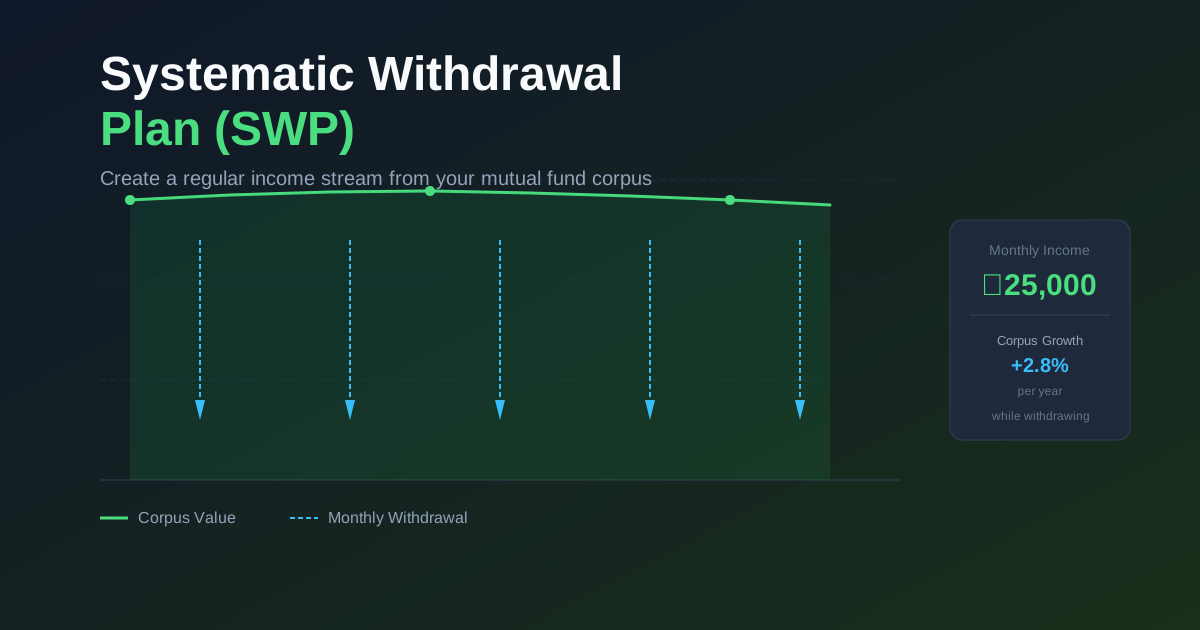
You've built the corpus. Now it's time to draw from it — intelligently. A Systematic Withdrawal Plan (SWP) is the structured exit strategy that lets your wealth keep compounding while you take a regular income. Here's the complete playbook.
What Is a Systematic Withdrawal Plan (SWP)?
An SWP lets you withdraw a fixed amount from your mutual fund investment at regular intervals — monthly, quarterly, or annually. The remaining units continue to grow at the fund's NAV.
It is the logical counterpart to SIP. While SIP builds wealth through systematic accumulation, SWP helps harvest wealth through systematic distribution — without liquidating the entire portfolio at once.
Think of it this way: during your working years, every salary credit is like a SIP — money flowing into your investments. After retirement, every SWP withdrawal is like a salary credit — money flowing out of your investments into your bank account, while the rest continues to compound.
How SWP Works
- Corpus Setup: You invest a lump sum into a mutual fund (typically a debt fund, balanced fund, or equity savings fund for SWP purposes).
- Withdrawal Mandate: You instruct the AMC to redeem a fixed number of units or a fixed rupee amount each period.
- Unit Redemption: On each withdrawal date, units are redeemed at the current NAV to fulfill the withdrawal amount.
- Residual Growth: The remaining corpus continues to earn returns.
The Key Dynamic
If your portfolio earns a return greater than your withdrawal rate, your corpus grows while you draw income. If withdrawals exceed returns, the corpus depletes — the rate of depletion depends on the spread.
Example: A ₹1 crore corpus in a fund earning 12% annually generates ₹12 lakhs in returns over a year. If you withdraw ₹6 lakhs annually (₹50,000/month), the corpus grows by ₹6 lakhs per year even while you draw income. Withdraw ₹12 lakhs or more, and the corpus remains flat or shrinks.Real-World Example: Building a Sustainable SWP
Scenario: ₹50 lakh corpus in a balanced fund at 10% annual return. Monthly withdrawal: ₹25,000.| Year | Opening Corpus | Returns Earned | Withdrawn | Closing Corpus |
|---|---|---|---|---|
| 1 | ₹50,00,000 | ₹5,00,000 | ₹3,00,000 | ₹52,00,000 |
| 5 | ₹57,30,000 | ₹5,73,000 | ₹3,00,000 | ₹60,03,000 |
| 10 | ₹67,50,000 | ₹6,75,000 | ₹3,00,000 | ₹71,25,000 |
| 20 | ₹88,10,000 | ₹8,81,000 | ₹3,00,000 | ₹93,91,000 |
To model your own scenario, use our SWP Calculator.
Benefits of SWP
1. Regular Predictable Income
SWP mimics a salary or pension — fixed monthly credits to your bank account — without surrendering the entire investment. You choose the date and amount.2. Tax Efficiency Over FD/RD
Fixed deposits tax interest as income at your slab rate every year — even if you reinvest it. SWP withdrawals (from equity funds held over 1 year) attract 12.5% LTCG only on the gains portion — not the principal portion of each withdrawal. For someone in the 30% income tax bracket, this difference can be worth lakhs over a 20-year retirement.3. Corpus Preservation and Growth
Done right, SWP allows your investment to outlive your withdrawal needs. Unlike annuities, you retain full capital ownership — your heirs inherit whatever corpus remains.4. Inflation Protection
An SWP from an equity or balanced fund participates in long-term market growth, which historically outpaces inflation. An FD returning 7% barely keeps pace with India's average 5-6% inflation in real terms.5. Flexibility and Control
You can adjust your withdrawal amount upward as expenses rise, pause SWP during market downturns and draw from a liquid fund buffer instead, or stop it entirely if your financial situation changes. No annuity lock-in.Tax Treatment (2026)
Every SWP withdrawal is treated as a redemption of mutual fund units. Only the gain component of each redemption is taxed — not the entire withdrawal amount. This is SWP's biggest tax advantage over FDs.
| Fund Type | Holding Period | Tax on Gains |
|---|---|---|
| Equity / Equity-oriented hybrid | > 1 year | 12.5% LTCG (gains above ₹1.25L/year exempt) |
| Equity / Equity-oriented hybrid | < 1 year | 20% STCG |
| Debt funds | Any period | Added to income, taxed at slab rate |
Risks to Manage
| Risk | Description | Mitigation |
|---|---|---|
| Sequence-of-Returns Risk | A market crash early in retirement depletes corpus faster because you're selling units at depressed prices | Keep 2 years of withdrawals in a liquid fund or short-term debt fund as a buffer |
| Withdrawal Rate Risk | Withdrawing more than fund returns = corpus erosion over time | Keep withdrawal rate at or below 4-5% annually of corpus |
| Inflation Risk | Static withdrawal loses purchasing power over 20-25 years | Use a Step-Up SWP — increase withdrawal 3-5% annually |
| Fund Performance Risk | Underperforming fund shrinks corpus faster than expected | Review fund performance annually; switch if consistently underperforming |
| Factor | SWP (Equity Hybrid) | Bank FD | Dividend Option |
|---|---|---|---|
| Monthly income predictability | High (you set the amount) | High | Low (market-linked) |
| Capital ownership | Full | Full | Full |
| Tax efficiency | High (LTCG only on gains) | Low (slab rate on full interest) | Low (taxed at slab) |
| Inflation protection | Yes (equity growth) | No (fixed rate) | Partial |
| Corpus growth | Yes (if withdrawal < returns) | Flat (principal intact) | Flat |
| Flexibility | High | Low (penalties on premature) | Medium |
Many investors confuse SWP with the "dividend" payout option in mutual funds. These are fundamentally different:
- Dividend option: The fund decides if/when to pay dividends based on distributable surplus. You have no control over amount or timing. Dividends are taxed at your slab rate.
- SWP: You control the exact amount and date. Only the gain portion is taxed at the lower capital gains rate.
Setting Up an SWP in India
Step 1: Accumulate the Corpus
If you're in the accumulation phase, start with SIP. Use our SIP Calculator to project how long it takes to reach your target corpus.A common rule of thumb: Target corpus = Desired monthly withdrawal × 300 (this gives you approximately 30 years of withdrawals at a 4% annual rate, assuming 10-12% fund returns).
Step 2: Choose the Right Fund for SWP
- Conservative (age 60+, low risk tolerance): Conservative hybrid fund (25-40% equity, 60-75% debt). Expected return 8-10%.
- Moderate (age 50-60, moderate risk tolerance): Balanced advantage / Dynamic asset allocation fund. Expected return 10-12%.
- Growth (age 45-55, high risk tolerance, large corpus): Flexi-cap or large-cap equity fund. Expected return 12-14%. Higher volatility requires a larger cash buffer.
Step 3: Set Up the SWP Mandate
On any major mutual fund platform (Groww, Zerodha Coin, Kuvera, or directly on the AMC website):
- Log in and navigate to the fund holding
- Select "SWP" or "Systematic Withdrawal Plan"
- Enter the monthly withdrawal amount
- Set the withdrawal date (5th-10th of each month is common)
- Link your bank account
- Confirm — the mandate is set
Step 4: Maintain a 2-Year Cash Buffer
Before starting SWP from your equity/hybrid fund, keep 24 months of withdrawals in a liquid fund or short-term FD. During market downturns (which happen every few years), draw from this buffer instead of your equity fund. This avoids selling equity units at depressed prices and gives your corpus time to recover.
Step 5: Annual Review
Every January, review:
- Is the corpus growing, shrinking, or stable?
- Have living expenses risen (requiring a higher withdrawal)?
- Is fund performance in line with projections?
- Does the cash buffer need replenishment?
The 4% Rule for India
The 4% rule (withdraw 4% of your corpus annually and it lasts 30 years) originated from US research. For India, a 3-4% rule is more appropriate due to:
- Higher average inflation (5-6% vs 2-3% in the US)
- Longer life expectancy (plan for 30-35 years of retirement)
- More frequent and deeper market corrections
For ₹50,000/month income: Target corpus of ₹1.5 crore (at 4% rule) to ₹2 crore (at 3% conservative rule).
Frequently Asked Questions
At what age should I switch from SIP to SWP? There's no fixed age. Switch to SWP when you no longer have active income and need your investments to fund expenses. Most people transition at retirement (55-65), but some do a partial SWP earlier for passive income alongside salary. Use our SWP Calculator to see if your corpus is ready. Can I run SIP and SWP simultaneously? Yes. Some investors run SIP on one fund (accumulation) while running SWP on another (distribution). This is a valid strategy for people with part-time income who also need to draw on their corpus. What if markets crash right after I start SWP? This is sequence-of-returns risk — the biggest SWP danger. Mitigation: before starting SWP, move 2 years of withdrawals into a liquid fund. Draw from the liquid fund during the crash. Your equity corpus gets time to recover without being depleted at low prices. Is SWP better than buying an annuity? For most investors, yes. Annuities offer guaranteed income but surrender capital permanently, have low returns (4-6%), and lock you into fixed terms. SWP keeps capital ownership, offers higher growth potential, and is fully flexible. The downside: SWP returns are not guaranteed. Annuities suit investors who prioritize certainty over returns. Can I withdraw more than the returns my fund earns? Yes, but your corpus will shrink over time. If your fund earns 10% and you withdraw 12%, your corpus shrinks by 2% annually. This may still be acceptable for a 20-year retirement — use our SWP Calculator to see exactly how long your corpus lasts under different scenarios. What is the minimum SWP amount? Most AMCs allow SWP from ₹500/month. There's no practical minimum — set it to whatever monthly amount your corpus can sustainably support.Conclusion
SWP is the retirement-grade tool that puts your money to work for you, not the other way around. When structured correctly, it provides income, preserves capital, and beats traditional instruments on tax efficiency.
The key to a successful SWP:
- Sufficient corpus (3-5 crores for a comfortable retirement, depending on lifestyle)
- Conservative withdrawal rate (3-4% annually)
- Right fund type for your risk tolerance
- 2-year cash buffer to handle market volatility
- Annual review to adjust for inflation and performance