12 Numbers to Check Before Buying a Stock (With a Worked Example)
Ratios won't tell you what to buy, but they're very good at telling you what to look at next. Here are 12 worth knowing, worked through on a sample company, plus the red flags that matter more than any of them.

Ram
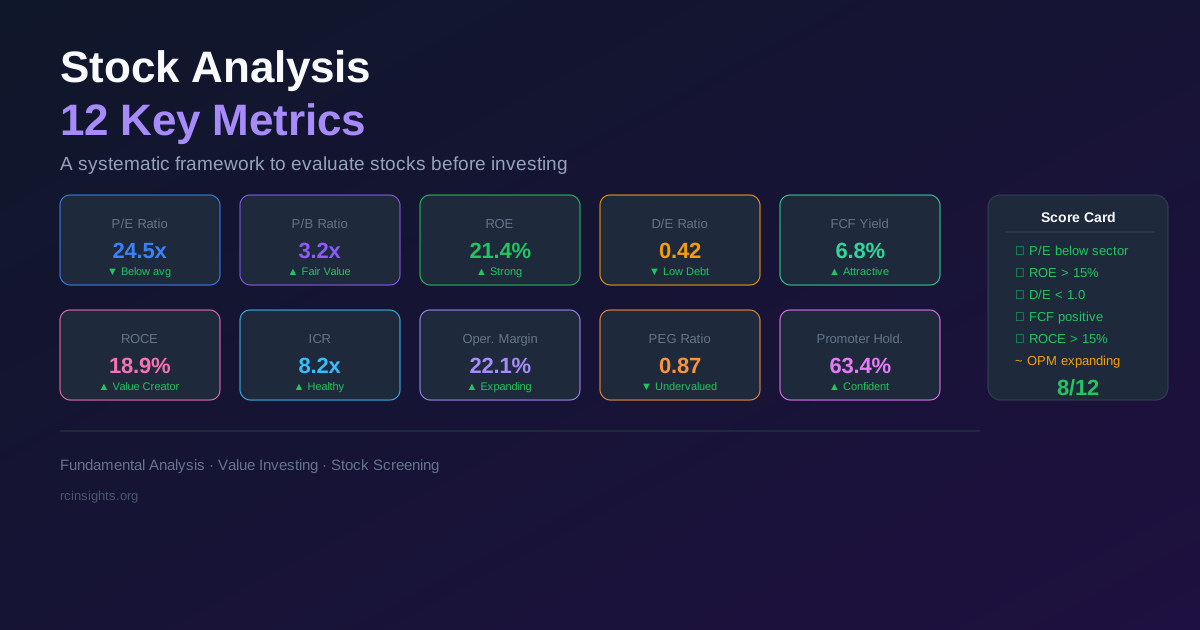
Stock tips are everywhere: WhatsApp groups, YouTube, a colleague's "sure thing". Fundamental metrics are the antidote. They won't tell you what to buy, but they're very good at showing what a company actually earns, owes and generates in cash, and at pointing out which questions to ask next.
Here are 12 worth knowing, then all of them applied to a sample company, and finally the red flags that no ratio will catch.
This is education, not investment advice or a stock recommendation. I'm not a SEBI-registered research analyst. Most people are better served by diversified funds for the bulk of their money.
Valuation: what are you paying?
1. Price-to-Earnings (P/E)
P/E = Share price ÷ Earnings per share (EPS)
How many rupees you pay for each rupee of yearly profit. On its own, a P/E tells you little. Compare it with the company's own history and with similar companies. A P/E of 50 can be normal for a steady consumer brand and alarming for a cyclical metals company.
2. Price-to-Book (P/B)
P/B = Share price ÷ Book value per share
Most useful where the assets on the balance sheet are the business, like banks and NBFCs. Less meaningful for software or consumer brands, whose real value (people, brands) isn't on the balance sheet.
3. PEG ratio
PEG = P/E ÷ Expected yearly earnings growth (%)
Adjusts P/E for growth. Around 1 suggests you're paying a fair price for the growth. But it's only as good as the growth estimate you put in, so test it with a more cautious number too.
Quality: how good is the business?
4. Return on Equity (ROE)
ROE = Net profit ÷ Shareholders' equity × 100
How much profit the company makes on shareholders' money. A high ROE (15–20% or more) sustained for many years often signals a real competitive advantage. But debt can inflate ROE, so always read it alongside #7.
5. Return on Capital Employed (ROCE)
ROCE = EBIT ÷ (Equity + Debt) × 100
Like ROE, but counts all the money used in the business, including borrowings. It's harder to inflate with debt, which makes it the better comparison between companies with different amounts of borrowing.
6. Operating margin
Operating margin = Operating profit (EBIT) ÷ Revenue × 100
How much of each rupee of sales is left after running the business. The trend matters more than the level. Rising margins suggest pricing power or efficiency from scale. Falling margins suggest competition or rising costs.
Safety: can it survive a bad year?
7. Debt-to-Equity (D/E)
D/E = Total borrowings ÷ Shareholders' equity
How much the company relies on borrowed money. For most non-financial businesses, under about 1 is comfortable, and above 2 deserves a close look. Don't apply this to banks and NBFCs. Borrowing is their raw material.
8. Interest coverage
Interest coverage = EBIT ÷ Interest expense
How many times operating profit covers the interest bill. Below about 1.5 is a warning sign. Above 3–4 is comfortable.
9. Free cash flow (FCF)
FCF = Cash from operations − Capital expenditure
The cash left after running the business and maintaining or expanding it. Reported profit involves many accounting judgements, so cash flow is a useful reality check. A company that reports profits year after year but rarely produces free cash flow deserves suspicion. FCF yield (FCF ÷ market value) also shows how much cash you're getting for the price you pay.
Growth and ownership
10. Revenue growth (3–5 year CAGR)
Use multi-year growth to smooth out one-off years. Then ask: is the growth organic, or bought through acquisitions? And is it coming with stable margins, or by cutting prices?
11. Promoter holding and pledges
From the quarterly shareholding pattern on NSE and BSE. A meaningful promoter stake means the people running the company have money at risk alongside you. Pledged promoter shares are a risk: if the price falls, lenders can sell those shares, pushing the price down further. A steadily falling promoter stake, or a pledge above roughly a quarter of promoter holdings, is worth investigating.
12. Dividend yield and payout ratio
Dividend yield = Yearly dividend per share ÷ Share price × 100
Payout ratio   = Dividends paid ÷ Net profit × 100
A very high payout leaves little to reinvest. A low payout is fine if the retained profit is earning a good ROCE. Dividends are taxed at your slab rate, so a high yield isn't automatically better for you.
A worked example: "ABC Foods" (made up)
A made-up mid-sized consumer foods company at ₹500 a share, with 10 crore shares:
- Market value ₹5,000 cr; net profit ₹220 cr (EPS ₹22); equity ₹1,800 cr (book value ₹180/share)
- Revenue ₹2,200 cr (₹1,600 cr three years ago); EBIT ₹310 cr; interest ₹35 cr
- Operating cash flow ₹280 cr; capex ₹60 cr; borrowings ₹700 cr
- Expected earnings growth 18% a year; dividend ₹5/share
| Metric | Working | Result | Reading |
|---|---|---|---|
| P/E | 500 ÷ 22 | 22.7× | Compare with peers and its own history |
| P/B | 500 ÷ 180 | 2.8× | Reasonable for a consumer brand |
| PEG | 22.7 ÷ 18 | 1.26 | Fair, if 18% growth holds |
| ROE | 220 ÷ 1,800 | 12.2% | Below the 15% we'd like. Why? |
| ROCE | 310 ÷ 2,500 | 12.4% | Same story |
| Operating margin | 310 ÷ 2,200 | 14.1% | Check the 5-year trend |
| D/E | 700 ÷ 1,800 | 0.39 | Comfortable |
| Interest coverage | 310 ÷ 35 | 8.9× | Comfortable |
| FCF | 280 − 60 | ₹220 cr | Matches profit, a good sign |
| FCF yield | 220 ÷ 5,000 | 4.4% | Decent |
| Revenue CAGR | (2,200 ÷ 1,600)^(1/3) − 1 | 11.2% | Solid. Organic or acquired? |
| Dividend yield / payout | 5 ÷ 500; 50 ÷ 220 | 1.0% / 23% | Keeps most profit to reinvest |
What this tells us: the balance sheet is safe, cash flow matches reported profit, and the valuation isn't stretched. The open question is returns on capital. A 12% ROE and ROCE is ordinary for a consumer brand.
The next step isn't buying. It's finding out why: did a recent factory expansion temporarily add capital that isn't earning yet? Are margins under pressure from competitors? That's what the annual report is for.
That's the right way to use metrics: to find the next question, not to reach the final answer.
Sector matters
The same number means different things in different industries:
- Banks and NBFCs: ignore D/E. Focus on P/B, ROE and ROA, net interest margin, gross and net NPAs (bad loans), and capital adequacy.
- IT services: usually little debt and high ROE, with value driven by margins and how reliably profit turns into cash.
- Consumer staples: steady earnings tend to earn high P/Es. Compare a company mainly with its own history.
- Cyclicals (metals, cement, autos): P/E is lowest when profits peak, which is often exactly the wrong time to buy. Look at mid-cycle earnings and EV/EBITDA instead.
- Loss-making companies: P/E doesn't apply. Look at revenue growth, gross margin, cash burn and how long their cash will last.
Red flags no ratio will show
Read these in the annual report and filings. They outweigh good-looking numbers:
- Qualified audit opinions, or repeated auditor changes.
- Large related-party transactions: money moving to entities connected to the promoters.
- Receivables or inventory growing much faster than sales. Money owed by customers or unsold stock piling up can mean sales are being booked that haven't really happened.
- Profit consistently far above operating cash flow.
- Promoters steadily selling or increasing pledges while management stays upbeat in public.
- Frequent equity issues that dilute existing shareholders, or acquisitions far outside the core business.
Where to find the data
- Screener.in: ten-year financials, ratios, peer comparisons and custom screens, free. The quickest way to run this checklist.
- NSE and BSE: official filings, shareholding patterns and announcements.
- The company's annual report: management discussion, segment details, related-party notes and the auditor's report. Read this before you put real money in.
A first pass through these 12 numbers on Screener takes about half an hour. Reading the annual report properly takes an evening. If you won't do the second part, a low-cost index fund is the honest alternative, and for most people it's the better one anyway.