SWP (Systematic Withdrawal Plan): Turning a Corpus Into a Monthly Income
An SWP pays you a fixed amount every month from a mutual fund, while the rest stays invested. Whether it lasts 15 years or 40 depends less on returns than on two things most guides skip: inflation and bad timing.

Ram
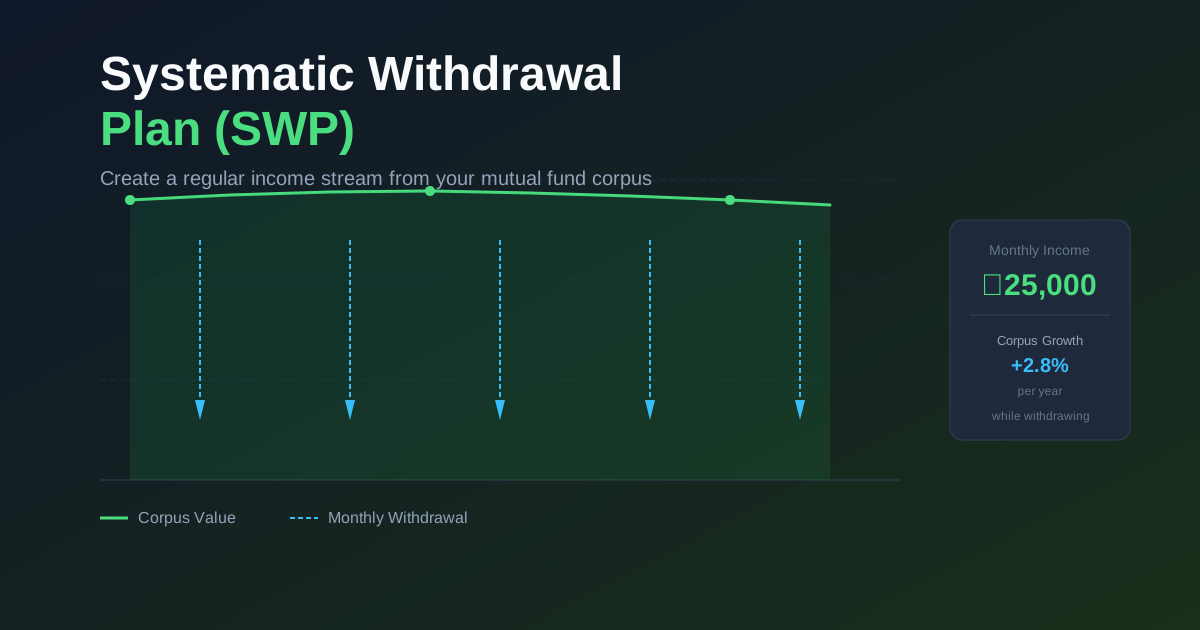
A Systematic Withdrawal Plan (SWP) is a SIP in reverse. Instead of a fixed amount going into a mutual fund each month, a fixed amount comes out to your bank account. The rest of the money stays invested and keeps earning.
It's one of the most flexible ways to turn savings into a monthly income, whether you're retired or just want a regular payout from a lump sum. But whether an SWP lasts 15 years or 40 depends mostly on two things that are easy to overlook: inflation and when the bad years arrive.
General information, not personalised advice. For retirement income, which you'll depend on for decades, it's worth getting a plan from a SEBI-registered investment adviser.
How it works
- You invest a lump sum in a mutual fund, or use one you've built up through SIPs.
- You set up an SWP: a fixed amount, on a fixed date, every month or quarter.
- On each date, the fund sells just enough units, at that day's NAV, to pay you.
- The remaining units stay invested.
If the fund earns more than you withdraw, the balance grows. If it earns less, the balance shrinks. You can change the amount, pause the SWP or stop it at any time.
The basic arithmetic
₹50 lakh in a fund earning 10% a year, withdrawing ₹25,000 a month (₹3 lakh a year, 6% of the starting amount):
| After | Corpus |
|---|---|
| 1 year | ₹51.9 L |
| 5 years | ₹61.4 L |
| 10 years | ₹79.7 L |
| 20 years | ₹1.57 Cr |
It looks like it can go on forever. On these assumptions it can. But they include two big ones: that ₹25,000 will always be enough, and that returns arrive smoothly.
The inflation problem
₹25,000 today will buy roughly what ₹14,000 buys in ten years, at 6% inflation. A retiree needs their withdrawal to grow. Same ₹50 lakh and same starting ₹25,000, but now raising the withdrawal 6% each year to keep up with prices:
| Fund return | How long the money lasts |
|---|---|
| 10% a year | About 28 years |
| 8% a year | About 21 years |
That's still a decent result, but it's a very different picture from "grows forever". And it shows why the return you assume matters so much. A 2-point difference cost seven years.
Plan an SWP with withdrawals that rise with inflation from the start. If you have a good year, you can always take less than planned.
The bad-timing problem (sequence of returns)
Average returns hide a nasty detail: when the bad years happen matters enormously once you're withdrawing.
Take ₹1 crore, withdrawing ₹40,000 a month (4.8% a year) and raising it 6% a year, in a fund averaging 10%. Then add one 25% fall:
| When the crash happens | Money lasts |
|---|---|
| No crash | 40+ years |
| Year 15 | About 31 years |
| Year 1 | About 22 years |
The same crash takes nine years off the plan when it comes early. The reason: you're selling units to pay yourself while prices are low, so there are fewer units left to benefit from the recovery.
The standard defence is a cash buffer. Keep 1–2 years of withdrawals in a liquid fund or short-term deposits, and pay yourself from that. Refill it from the main fund in good years. In a bad year, stop refilling and let the main fund recover, rather than selling it at a low point.
How much can you withdraw?
You'll hear about the "4% rule": withdraw 4% of your starting corpus in year one, raise it with inflation, and it should last about 30 years. That came from US research, where inflation has been lower than India's. With higher inflation here, and retirements that can run 30–35 years, many Indian planners use 3–3.5% as a safer starting point.
| Starting corpus | 3% a year | 4% a year |
|---|---|---|
| ₹1 crore | ₹25,000 / month | ₹33,300 / month |
| ₹2 crore | ₹50,000 / month | ₹66,700 / month |
Working backwards: for ₹50,000 a month in today's money, you'd want roughly ₹1.5 to 2 crore. Use these as rough guides, not guarantees, and revisit the plan every year.
Which fund to withdraw from
Pick the fund on how much ups and downs you can live with, and how it's taxed:
- Balanced advantage / dynamic asset allocation funds shift between equity and debt according to valuations. Many hold enough equity, partly through arbitrage positions, to be taxed as equity funds. This makes them a popular core holding for an SWP.
- Equity funds (large-cap, flexi-cap) have the highest long-term growth and the biggest falls. They only suit someone with a large corpus and a solid cash buffer.
- Conservative hybrid and debt funds are steadier, but for units bought after April 2023, gains are taxed at your slab rate, the same as FD interest. That removes most of their tax advantage.
- Funds with 35–65% equity fall in a middle tax category with its own rules. Check the fund's factsheet or ask the fund house how it's taxed before relying on it.
A common setup: a cash buffer in a liquid fund, most of the money in a balanced advantage fund, and perhaps a slice in an index fund for long-term growth.
How SWP withdrawals are taxed
Each withdrawal is a sale of units, so only the gain in that withdrawal is taxed, not the whole amount. Units are sold oldest first.
For equity-oriented funds (65% or more in Indian equity):
- Held over 12 months: 12.5% on long-term gains above ₹1.25 lakh a year.
- Held 12 months or less: 20%.
That ₹1.25 lakh yearly exemption matters a lot. In the early years of an SWP, much of each withdrawal is your original money coming back, and the gain portion can easily stay under ₹1.25 lakh a year. That means no tax at all.
Compare that with a fixed deposit, where all the interest is taxed at your slab rate every year, whether you spend it or not. The difference grows over a long retirement, especially if you have other income that pushes you into a higher slab.
For debt-heavy funds bought after April 2023, gains are taxed at your slab rate, the same as FD interest.
Tax rules change. Check the current position before you set up a large SWP.
SWP vs dividends (IDCW) vs annuities
- IDCW (what used to be called the "dividend option"): the fund decides whether and how much to pay you, and every payout is taxed at your slab rate. You have less control and usually pay more tax than with an SWP.
- Annuity: you hand over a lump sum to an insurer in exchange for a guaranteed lifelong income. It's certain, but the rates are modest, the income is fully taxable, and depending on the plan you choose, the capital may not go to your heirs. Some people combine the two: an annuity to cover essential bills, and an SWP for everything else.
Setting one up
- Build or move the corpus into the fund or funds you've chosen. Choose "Direct" plans so you don't pay distributor commission for the rest of your life.
- Fill the cash buffer with 1–2 years of withdrawals in a liquid fund.
- Register the SWP on your platform or the fund house's website: the amount, the date (a few days before your monthly bills are due) and your bank account.
- Review once a year. Raise the withdrawal for inflation if the corpus is healthy. Hold it steady after a bad year. Refill the buffer when markets are up.
The SWP calculator lets you test your own corpus, withdrawal and return. Try it at a lower return than you expect, too. If the plan only works at 12%, it doesn't really work.
Still building the corpus? The SIP beginner's guide and the step-up SIP guide cover that side.