ELSS vs PPF vs NPS: Which 80C Option Actually Fits You?
Before comparing ELSS, PPF and NPS, answer one question: are you even on the old tax regime? If you are, here's how the three compare on returns, lock-in and tax, with current numbers.

Ram
Every January and February, HR sends the "submit your investment proofs" email, and a lot of us rush to put money somewhere, anywhere, that counts under 80C. This post is meant to help you make that decision calmly, preferably in April instead.
General information, not personalised advice. Tax rules change with each Budget, so check the current position or ask a qualified adviser before you act.
First: does 80C even apply to you?
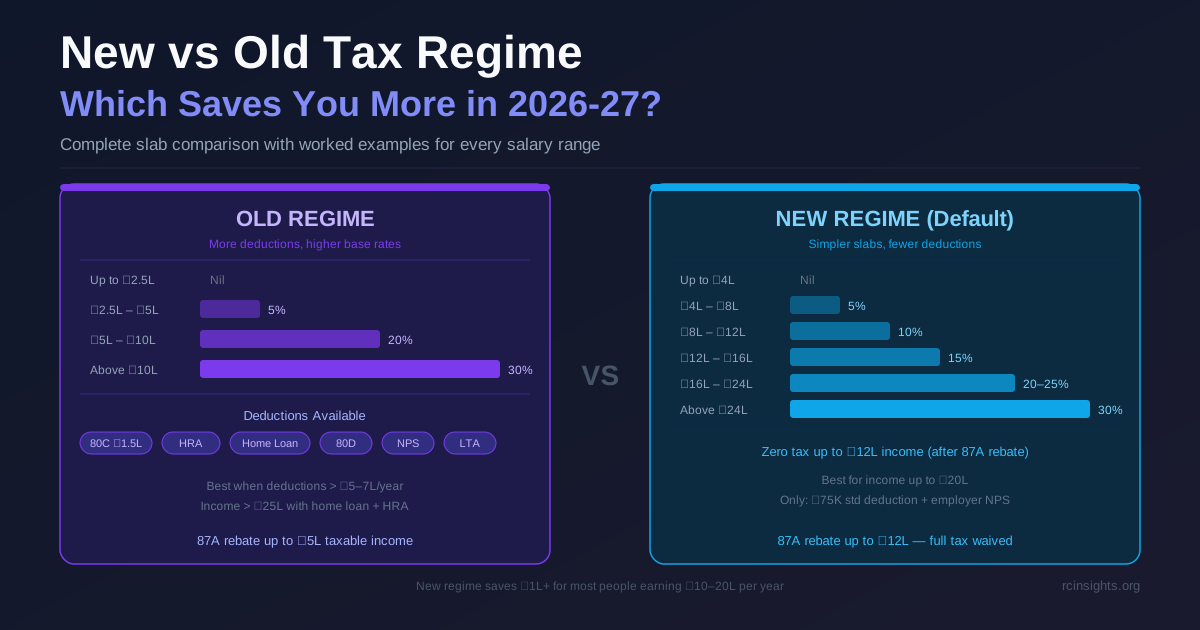
Since FY 2023-24, the new tax regime has been the default, and it doesn't allow 80C deductions at all. After Budget 2025, it's also hard to beat for most salaried people. There's no tax up to ₹12 lakh of taxable income (₹12.75 lakh of salary, after the ₹75,000 standard deduction). Budget 2026 kept those slabs unchanged.
So the honest starting point is:
- On the new regime? ELSS, PPF and NPS give you no tax deduction. Judge them purely as investments. More on that at the end.
- On the old regime? You get up to ₹1.5 lakh a year in deductions under 80C, plus another ₹50,000 for NPS under 80CCD(1B).
From April 2026, the new Income-tax Act, 2025 replaced the 1961 Act and renumbered the sections. 80C is now Section 123. The limits and eligible investments are unchanged. Most people, and most HR portals, still say "80C", so this post does too.
Not sure which regime is better for you? The old vs new regime guide works through it with numbers.
How much 80C is actually worth
The deduction reduces your taxable income, so what you save depends on your slab (rates below include 4% cess, before any surcharge):
| Your old-regime slab | Tax saved on the full ₹1.5 lakh | Extra saved on ₹50,000 NPS (80CCD(1B)) |
|---|---|---|
| 5% | ₹7,800 | ₹2,600 |
| 20% | ₹31,200 | ₹10,400 |
| 30% | ₹46,800 | ₹15,600 |
Check what's already counted. Your own EPF contribution, the employee share on your payslip, counts towards 80C. So do life insurance premiums, home-loan principal repayment and children's tuition fees. Many people find EPF alone covers most of the ₹1.5 lakh. Add those up before investing anything new.
The three side by side
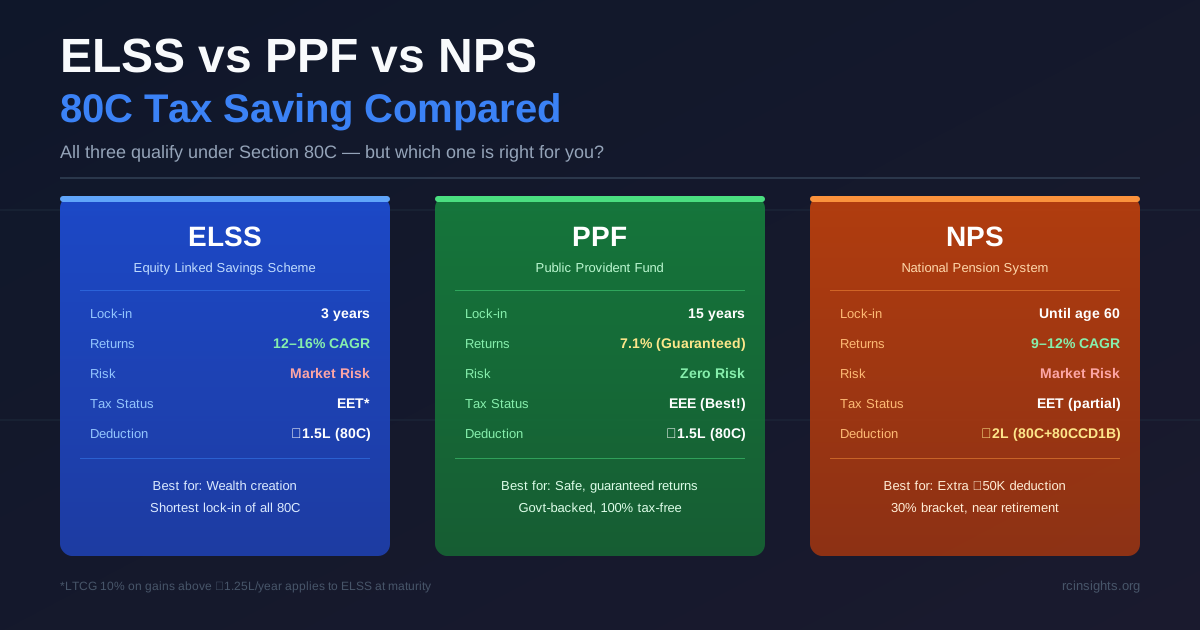
| ELSS | PPF | NPS (Tier I) | |
|---|---|---|---|
| What it is | An equity mutual fund | Government savings scheme | Market-linked pension account |
| Return | Market-linked, not guaranteed | 7.1% a year (Oct–Dec 2026), reset quarterly | Market-linked; depends on equity/debt mix |
| Lock-in | 3 years per instalment | 15 years (partial withdrawals from year 7) | Until 60, with limited exceptions |
| Tax on gains | 12.5% on long-term gains above ₹1.25 lakh/year | Fully tax-free | Mostly tax-free lump sum; annuity income is taxable |
| Deduction | Within ₹1.5 lakh (80C) | Within ₹1.5 lakh (80C) | Extra ₹50,000 (80CCD(1B)) on top of 80C |
ELSS: shortest lock-in, equity risk
ELSS (Equity Linked Savings Scheme) is a diversified equity fund with a three-year lock-in, counted separately for each instalment. That's the shortest lock-in of any 80C option.
It's also the only one with full equity exposure. That means it has the best long-run growth potential, and it can fall 30–40% in a bad year. A ₹12,500/month SIP (₹1.5 lakh a year) for 15 years grows to roughly ₹52 lakh at 10% a year, or ₹63 lakh at 12%. Those are illustrations, not promises.
Gains over ₹1.25 lakh a year are taxed at 12.5% when you sell. That's still lighter than the tax on most fixed-income options.
Suits: people on the old regime, with at least a 5–7 year horizon, who won't panic when the value drops.
PPF: boring, safe, completely tax-free
PPF is backed by the government, and it's tax-free at every stage: what you put in, the interest, and the withdrawal (called EEE, exempt-exempt-exempt). The rate is 7.1% right now. It's set every quarter and hasn't changed in more than two years.
₹1.5 lakh a year for 15 years at 7.1% comes to about ₹40.7 lakh, all of it tax-free.
The catch is the 15-year lock-in. Partial withdrawals are allowed from the seventh year, and loans against the balance are possible earlier. After 15 years, you can extend it in 5-year blocks.
Suits: anyone who wants guaranteed, tax-free money for a distant goal, and as the "safe" part of a portfolio. One small tip: deposit before the 5th of the month. Interest is calculated on the lowest balance between the 5th and the end of each month, so a deposit on the 6th earns nothing for that month.
NPS: the extra ₹50,000, with strings attached
NPS is a pension account regulated by PFRDA. You choose how much goes into equity versus bonds, or let it shift automatically as you age. The main reason people open one for tax is the additional ₹50,000 deduction under 80CCD(1B), on top of the ₹1.5 lakh.
The trade-off is that the money is locked until 60. The withdrawal rules changed in December 2025 for non-government subscribers:
- At 60, you can now take up to 80% as a lump sum. Only 20% has to buy an annuity (a monthly pension), down from 40%.
- If your total corpus is ₹8 lakh or less, you can withdraw all of it.
- You can defer withdrawals up to age 85.
Government employees still follow the older 60:40 split. Also, as of this writing, how the extra 20% lump sum will be taxed hasn't been fully clarified. Check before you plan around it.
Suits: people on the old regime who've already used the ₹1.5 lakh and genuinely want retirement savings they can't touch.
One NPS benefit works under both regimes: your employer's contribution to NPS under 80CCD(2). It's deductible up to 14% of basic salary under the new regime. If your company offers it as a salary-structuring option, it's worth asking HR about.
So which one?
Two questions narrow it down quickly.
1. When might you need this money?
- Within 5 years → none of these. Use an FD or a debt fund, and don't let a tax deduction lock up money you'll need.
- 5 to 15 years → ELSS, or PPF if you can't stomach market swings.
- Retirement → PPF and NPS work well, alongside equity.
2. How would you feel if it dropped 30% next year?
- Couldn't sleep → PPF.
- Fine, I'd keep investing → ELSS, and NPS with a higher equity share.
A common, sensible split on the old regime: count your EPF first, put most of the remaining 80C room into ELSS through a monthly SIP from April, keep some PPF for safety, and add ₹50,000 to NPS if you want the extra deduction and don't mind the lock-in.
If you're on the new regime
Then judge these as investments, with no tax angle:
- ELSS becomes "an equity fund with a 3-year lock-in for no reason." A regular index or flexi-cap fund does the same job with no lock-in.
- PPF still has tax-free interest and tax-free maturity. For safe, long-term money, 7.1% tax-free is a fair deal, especially if you're in a high slab.
- NPS has no 80CCD(1B) deduction. The employer contribution under 80CCD(2) is still worth using if your company offers it.
Mistakes worth avoiding
Buying an insurance policy "for tax saving." Traditional endowment and money-back plans sold in March often return 5–6% a year with long lock-ins and steep penalties for stopping early. Buy term insurance for protection, and invest separately.
The March lump sum. Putting ₹1.5 lakh into ELSS in the last week of the financial year works for tax purposes, but it's stressful, and it puts everything in at one price. A ₹12,500 SIP starting in April spreads it out and takes care of itself.
Forgetting EPF already counts. Check your payslip. If your PF deduction is ₹10,000 a month, that's ₹1.2 lakh of 80C covered already, and you only need ₹30,000 more.
Exiting ELSS just because the lock-in ended. Three years is the minimum, not the plan. If the goal is still years away, there's no reason to sell.
Choosing a regime by habit. Re-check every year. With the current new-regime slabs, many people are claiming deductions they'd be better off without.